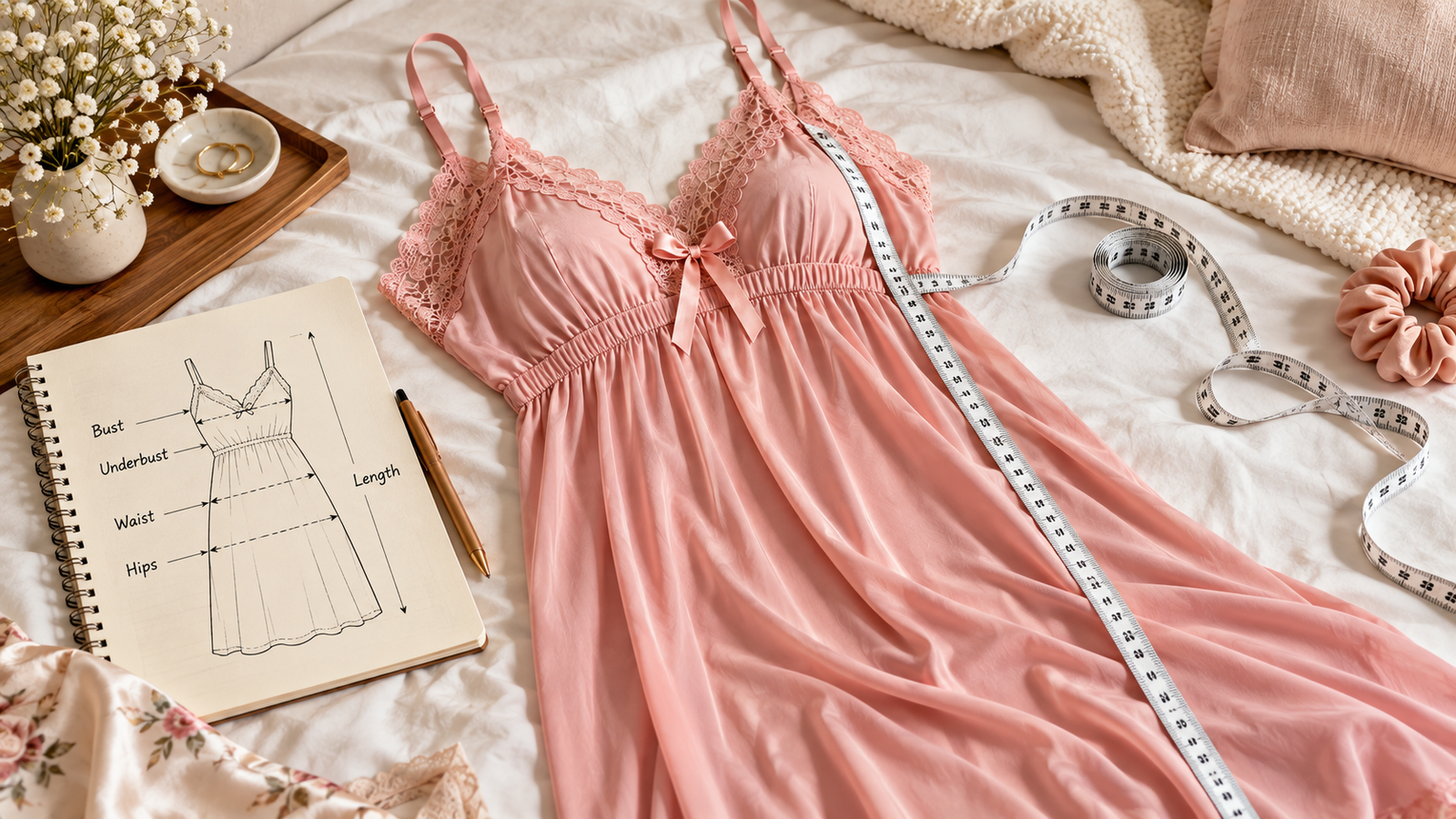
Buying a nightgown in the right size starts with accurate measurements.
But measuring yourself for a nightgown isn’t exactly the same as measuring yourself for jeans or fitted clothing. A nightgown needs enough room for your body to move comfortably, and the right measurements depend on whether you’re buying a loose nightie, a fitted sleep dress, a long nightgown, or a style with a defined bust or waist.
The good news?
You only need a few basic measurements to get started.
For most nightgowns, measure your bust, waist, hips, and preferred garment length, then compare those measurements with the specific brand’s size chart.
Don’t rely on your usual S, M, or L.
Women’s clothing sizes aren’t standardized across every brand, and a nightgown’s intended fit can also change how much room the garment provides.
This guide shows you exactly how to measure for a nightgown, how to take accurate nightgown measurements, and how to use those numbers when choosing your size.
Quick Answer: What Measurements Do You Need for a Nightgown?
For most styles, start with these four:
- Bust: Measure around the fullest part of your bust.
- Waist: Measure around your natural waist.
- Hips: Measure around the fullest part of your hips.
- Length: Decide where you want the nightgown hem to fall and measure accordingly.
Depending on the design, you may also need:
- Shoulder width
- Sleeve length
- Arm circumference
- Underbust
- Torso length
A loose, flowing nightgown may not need all of these.
A fitted or structured nightgown might.
Official clothing size guides from brands such as Patagonia, Levi’s, and L.L.Bean similarly use bust/chest, waist, and hip measurements as core body measurements, while garment-specific designs can require additional dimensions.
What You Need Before You Start
You don’t need special equipment.

Grab:
- A flexible measuring tape
- A mirror
- A notebook or phone
- A well-fitting, lightweight undergarment
- Someone to help if possible
A flexible sewing tape works much better than a rigid construction tape because it can follow the curves of your body.
The most important rule
Don’t pull the tape tight.
It should sit against your body without digging into your skin.
Several established clothing size guides recommend keeping the tape level and snug rather than tight when taking body measurements.
Before You Measure: Check the Nightgown’s Intended Fit
This step is easy to skip.
Don’t measure yourself first and assume every nightgown should fit the same way.
Look at the product description and determine whether the garment is:
- Fitted
- Slim
- Regular
- Relaxed
- Oversized
- A-line
- Loose
- Stretchy
- Structured
A relaxed nightgown needs more visual and physical ease than a fitted sleep dress.
This is why your body measurements alone don’t determine the final fit.
The garment’s cut matters too.
Patagonia, for example, separates fit into categories such as formfitting, slim, regular, relaxed, and oversized, demonstrating why the same body measurement can translate into very different garment silhouettes.
Step 1: Measure Your Bust
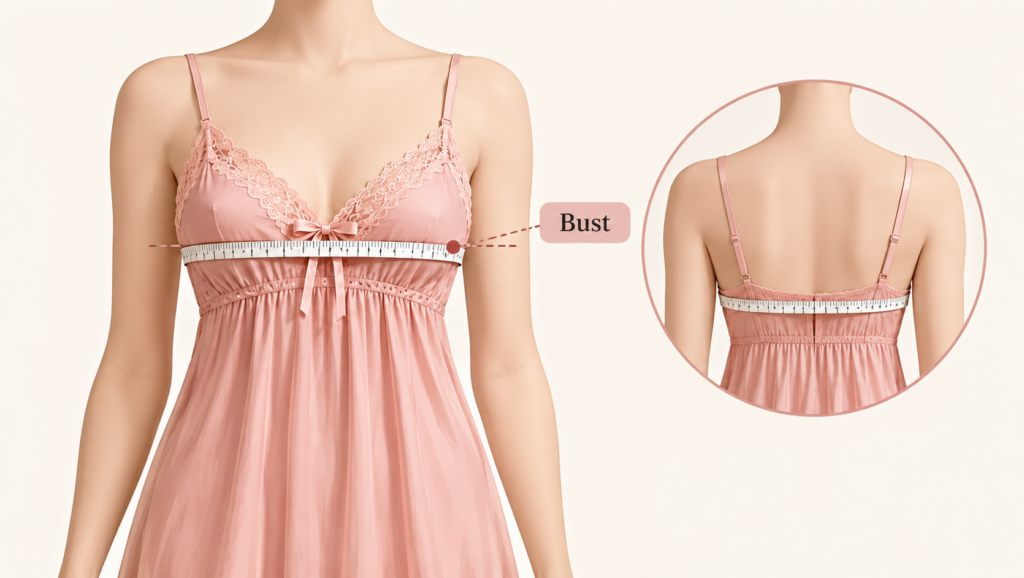
Your bust measurement is one of the most important nightgown measurements, particularly for styles with fitted bust areas, seams, cups, or narrower armholes.
How to measure your bust
- Stand naturally with your feet relaxed.
- Keep your arms down.
- Wrap the measuring tape around the fullest part of your bust.
- Keep the tape horizontal across your back.
- Make sure the tape isn’t pulling tightly.
- Record the measurement.
Don’t hold your breath or push your chest forward.
Just stand normally.
Several established clothing guides use the fullest part of the bust or chest as the reference point and emphasize keeping the tape level.
Why bust measurement matters
A nightgown can have plenty of room through the hips and still feel restrictive around the bust.
This becomes particularly important with:
- Fitted nightgowns
- Empire-waist styles
- Chemise-style nighties
- Button-front designs
- Lace-trimmed fitted garments
- Nightgowns with shaped cups
If you’re choosing a loose A-line nightgown, the bust may still be the measurement that determines your size, depending on the brand’s chart.
Step 2: Measure Your Natural Waist
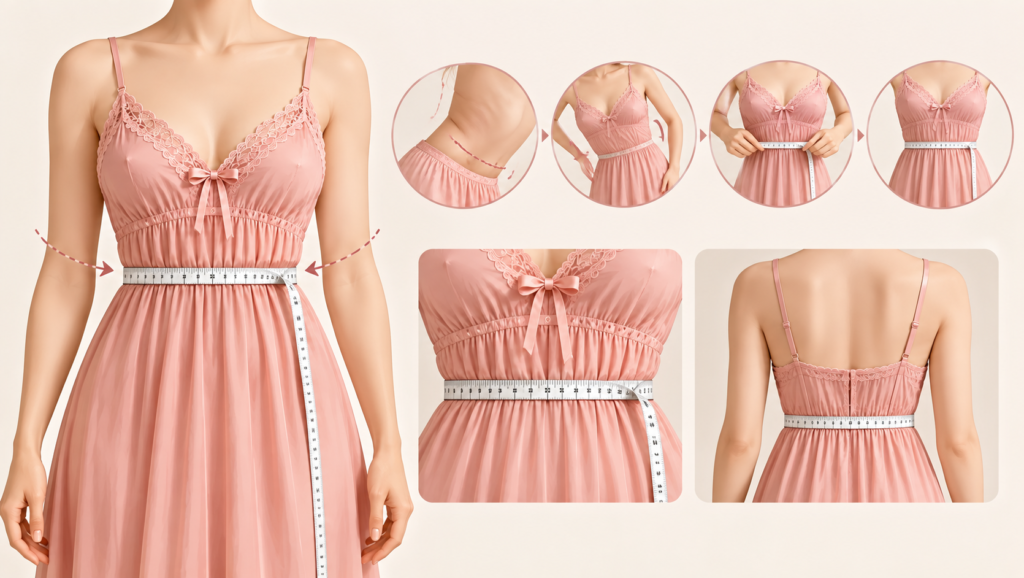
Your natural waist isn’t necessarily where you wear your trousers or pajama waistband.
To find it:
- Stand naturally.
- Bend slightly to one side.
- Notice where your body naturally creases.
- Return to an upright position.
- Place the tape around that area.
- Keep it comfortably snug.
- Record the measurement.
This approach is also used in established clothing measurement guides for locating the natural waist.
Don’t suck in your stomach
This is one of the easiest ways to get an inaccurate measurement.
You want your normal standing measurement, not the smallest number you can temporarily create.
A nightgown needs to fit the body you actually move and sleep in.
When waist measurement matters most
Waist measurements become particularly useful when shopping for:
- Fitted nightgowns
- Empire-waist designs
- Shaped sleep dresses
- Belts or waist ties
- More structured nightgowns
For very loose styles, the waist may be less important than bust and hip measurements.
Step 3: Measure Your Hips

Your hip measurement becomes especially important when the nightgown narrows around the lower body or uses a less forgiving fabric.
How to measure your hips
- Stand with your feet comfortably together or in the position recommended by the brand’s size guide.
- Wrap the tape around the fullest part of your hips and seat.
- Keep the tape horizontal.
- Don’t pull it tight.
- Record the measurement.
Levi’s and Patagonia both recommend measuring around the fullest part of the hips/seat while keeping the tape level.
Why hip measurement matters
A short, loose nightgown may not need much hip-specific sizing.
A longer, fitted nightgown does.
The difference becomes even more noticeable with:
- Straight-cut nightgowns
- Body-skimming styles
- Satin nightgowns
- Knitted sleep dresses
- Stretch-free woven fabrics
If your hip measurement is significantly larger than your bust measurement, don’t automatically choose based on the smaller measurement.
Check the brand’s sizing instructions and the garment’s cut.
Step 4: Measure Your Desired Nightgown Length
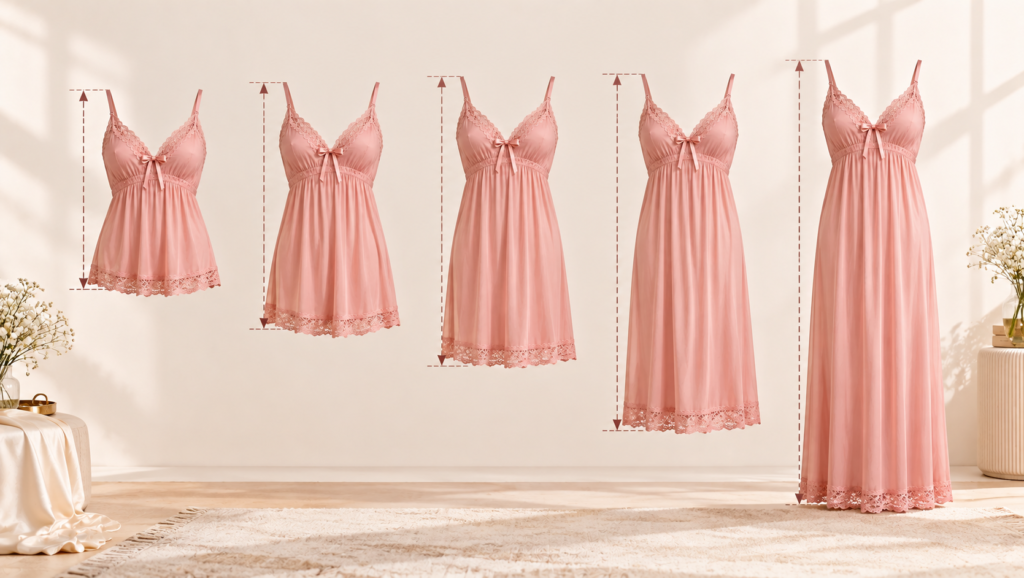
This measurement is slightly different.
You’re not measuring your body for a standardized size.
You’re deciding where you want the garment to end.
Think about the length you want:
- Upper thigh
- Mid-thigh
- Above knee
- Knee
- Below knee
- Mid-calf
- Ankle
Then use a measuring tape to estimate that distance from your shoulder or another reference point specified by the retailer.
Why this matters
A “medium” nightgown can fit your bust perfectly and still feel too long or too short.
This becomes particularly important if you’re:
- Petite
- Tall
- Between standard height ranges
- Shopping for a maxi nightgown
- Buying a long nightdress
- Choosing a loose sleep dress
Better method for online shopping
If the product page provides a garment length, compare it with a nightgown or dress you already own.
Lay your existing garment flat.
Measure its length.
Then compare that measurement with the product listing.
This is often more useful than guessing based on the model’s height in a product photograph.
Step 5: Measure Your Underbust If the Nightgown Has a Defined Bust
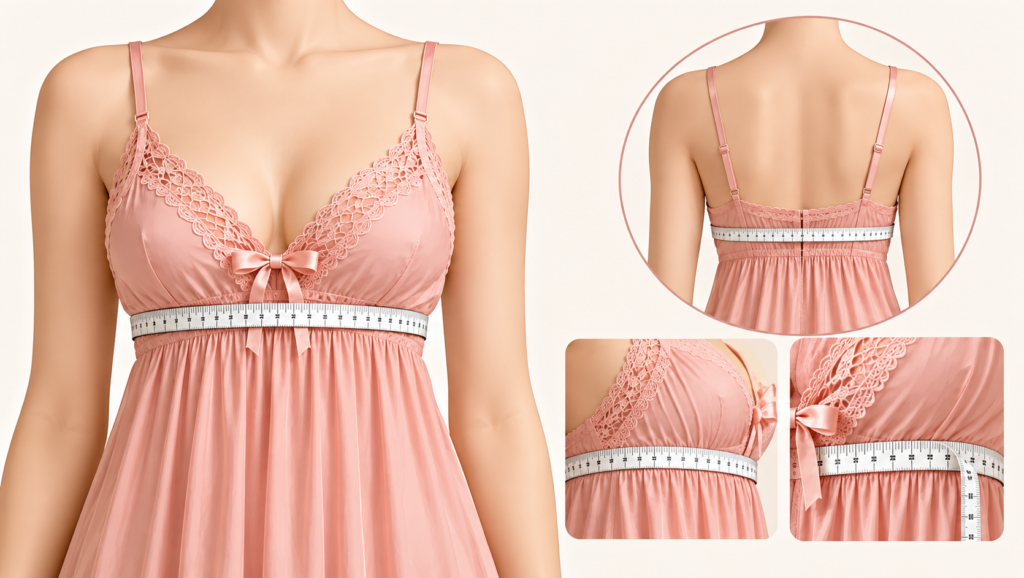
Not every nightgown requires an underbust measurement.
But if the garment has:
- Built-in cups
- An underbust seam
- A fitted empire seam
- Bra-like support
- Structured bust construction
then the underbust can help.
How to measure
Wrap the tape directly around your ribcage underneath your bust.
Keep it comfortably snug without compressing your body.
Record the measurement separately from your full bust measurement.
Then check whether the product’s size chart specifically asks for it.
Don’t calculate a bra size from this measurement unless the garment’s sizing system actually uses bra measurements.
A nightgown with a built-in bust area isn’t automatically sized like a bra.
Step 6: Measure Your Shoulders for Structured Styles
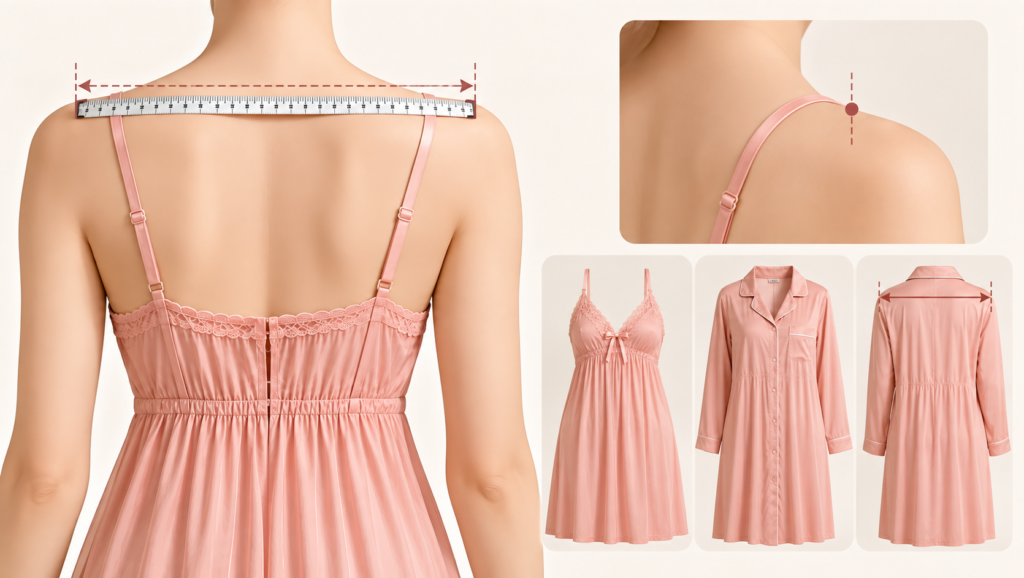
Shoulder measurement usually matters more for structured nightgowns than loose nighties.
If the garment has:
- Defined shoulder seams
- Long sleeves
- A tailored upper body
- Button-down construction
- A fitted neckline
check whether the manufacturer provides shoulder measurements.
Don’t automatically assume your shoulder measurement corresponds directly to the garment’s shoulder width.
A garment measurement and a body measurement aren’t always the same thing.
Step 7: Measure Your Arm if You’re Buying Sleeved Nightwear
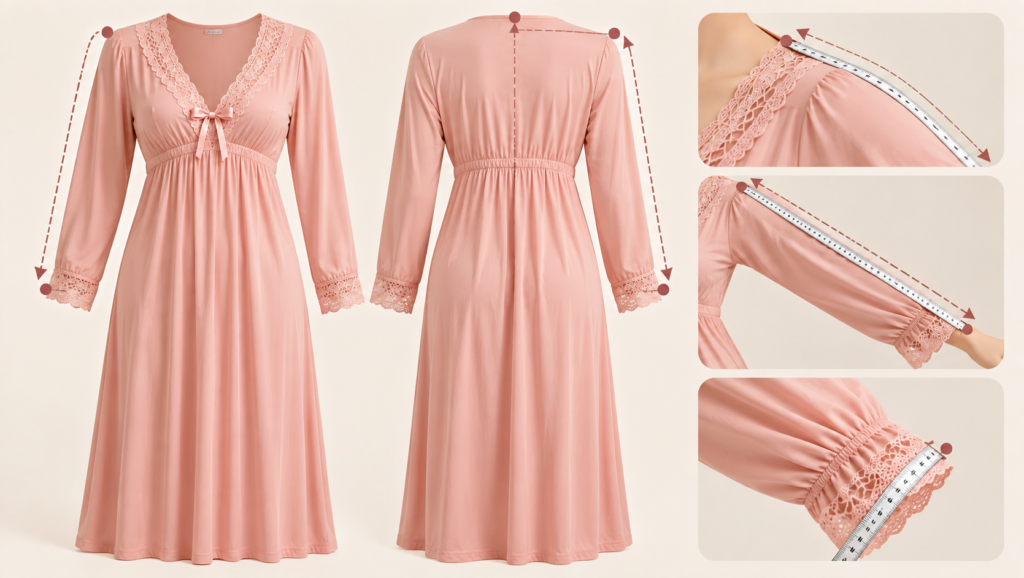
Sleeve length matters if you’re choosing:
- Long-sleeve nightgowns
- Button-down nightgowns
- Robe-style sleepwear
- Cold-weather sleep dresses
Different brands measure sleeve length differently.
Some measure from the shoulder seam.
Others measure from the center back or another reference point.
So if a retailer provides a sleeve-length diagram, follow that exact method.
Don’t compare a sleeve measurement from one brand with another unless you know they use the same measurement method.
Your Nightgown Measurements Checklist
Before opening the size chart, you should ideally have:
| Measurement | Needed for | How to measure |
|---|---|---|
| Bust | Most fitted styles | Around fullest part |
| Waist | Fitted/defined waist styles | Around natural waist |
| Hips | Longer or fitted styles | Around fullest part |
| Length | Choosing garment length | Compare desired hem position |
| Underbust | Structured bust styles | Around ribcage below bust |
| Shoulder | Structured garments | Follow brand’s method |
| Sleeve | Long-sleeve styles | Follow brand’s method |
You don’t necessarily need all seven.
Start with the measurements the retailer’s size chart asks for.
How to Use Your Nightgown Measurements With a Size Chart
Once you’ve measured yourself, don’t immediately choose the size with the closest number.
First, identify what the chart represents.
Some charts list body measurements.
Others may list garment measurements.
Those aren’t interchangeable.
Body measurement chart
A body measurement chart might say:
| Size | Bust | Waist | Hips |
|---|---|---|---|
| S | 34″ | 28″ | 37″ |
| M | 36″ | 30″ | 39″ |
| L | 38″ | 32″ | 41″ |
Those numbers describe the intended body measurements for the size.
Garment measurement chart
A garment chart might instead tell you the actual measurements of the finished nightgown.
Those numbers will often be larger because the garment needs room around the body.
Don’t compare your body measurement directly with a garment measurement as if they were the same thing.
This is one of the most common online-sizing mistakes.
What If Your Measurements Fall Between Two Sizes?
This happens all the time.
Suppose your measurements sit between M and L.
Don’t automatically choose the larger size.
Look at the garment.
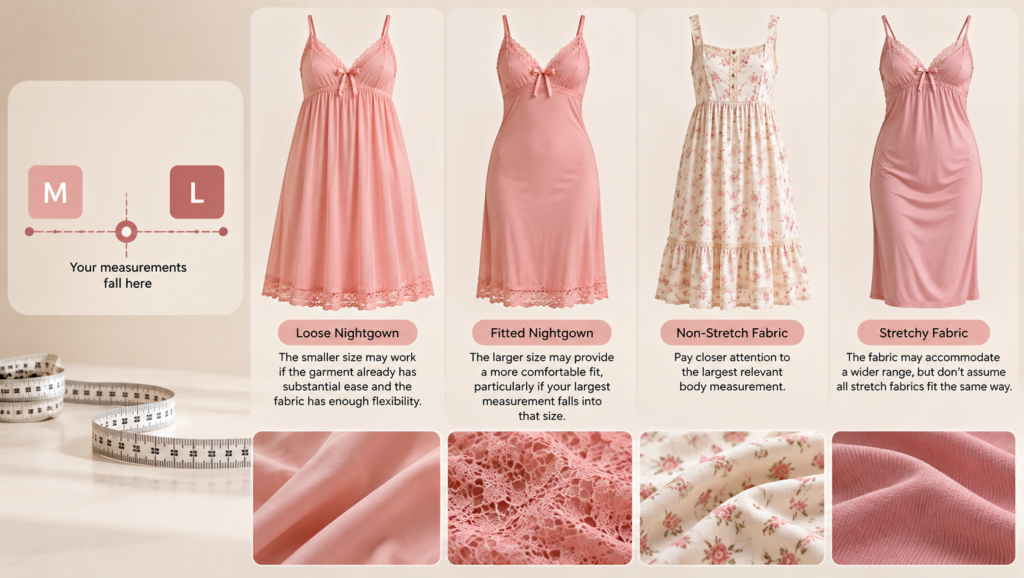
For a loose nightgown
The smaller size may work if the garment already has substantial ease and the fabric has enough flexibility.
For a fitted nightgown
The larger size may provide a more comfortable fit, particularly if your largest measurement falls into that size.
For non-stretch fabric
Pay closer attention to the largest relevant body measurement.
For stretchy fabric
The fabric may accommodate a wider range, but don’t assume all stretch fabrics fit the same way.
The brand’s own size chart and fit notes should take priority.
Which Measurement Should You Prioritize?
There’s no universal rule that says bust, waist, or hips always wins.
It depends on the garment.
Fitted Nightgown
Prioritize:
- Bust
- Hips
- Waist
- Length
Loose Nightgown
Prioritize:
- Bust
- Length
- Hips
- Waist
A-Line Nightgown
Prioritize:
- Bust
- Length
The lower portion usually has more room.
Long Straight-Cut Nightgown
Prioritize:
- Bust
- Hips
- Length
Built-In Bra Nightgown
Prioritize:
- Bust
- Underbust
- Waist
- Hips
The exact order can change depending on the manufacturer’s construction.
How Much Ease Should a Nightgown Have?
This is where measuring gets more interesting.
Your body measurement isn’t supposed to equal the garment measurement for a loose nightgown.
The difference is called ease.
For example:
If your bust measures 36 inches and a relaxed nightgown measures 42 inches around the bust, the garment has approximately 6 inches of additional room at that point.
That doesn’t mean you need to add six inches yourself.
The manufacturer has already built the ease into the garment.
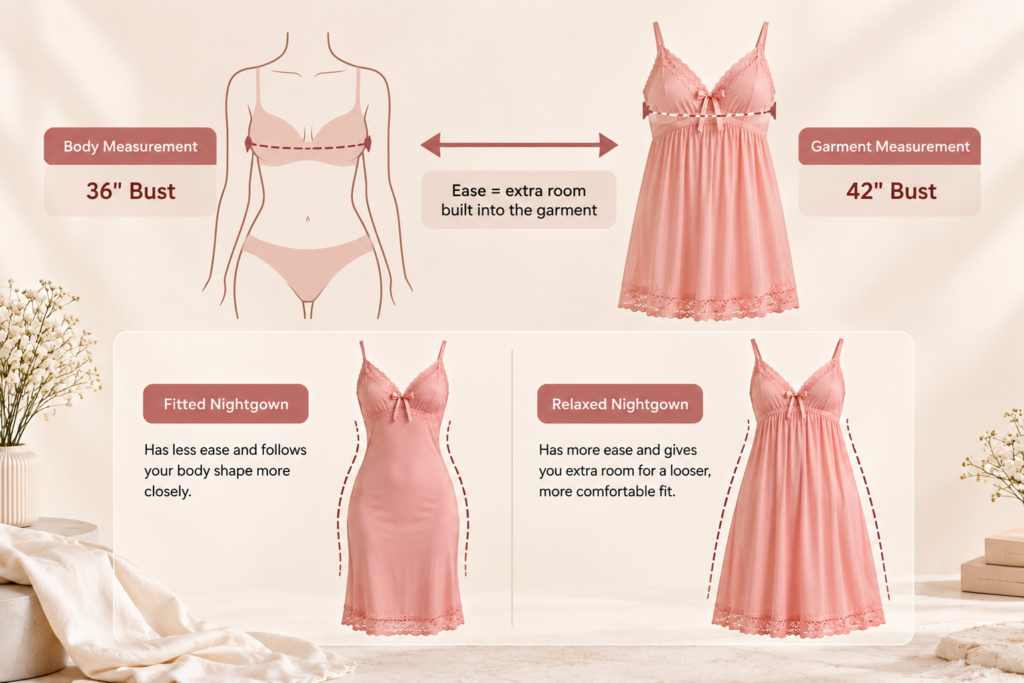
Ease depends on style
A loose nightie needs more room.
A fitted sleep dress needs less.
A stretch jersey nightgown behaves differently from a woven satin style.
A flowy A-line nightgown may have very little shaping around the waist because its lower body expands outward.
Should You Measure Over Clothes?
Ideally, take body measurements with minimal clothing or over lightweight, close-fitting undergarments.
Heavy clothing can add unnecessary circumference and distort the result.
If you have to measure over clothing, use a thin garment and keep the tape positioned consistently.
Lands’ End recommends measuring over well-fitting undergarments in its sizing guidance.
Should Someone Else Measure You?
If possible, yes.
You can measure yourself, but another person can often keep the tape level more accurately around your back and hips.
This becomes particularly helpful for:
- Bust
- Hip
- Shoulder
- Back measurements
If you’re measuring alone, use a mirror to check that the tape remains horizontal.
How Tight Should the Measuring Tape Be?
Think snug, not squeezed.
The tape should touch your body without digging into it.
If you pull it tightly, you’ll record a smaller number than your actual body measurement.
If you leave it hanging loosely, you’ll record a larger number.
Both can lead you toward the wrong size.
Levi’s specifically advises keeping the measuring tape flat against the body without making it too tight when measuring the waist, while its hip instructions emphasize keeping the tape horizontal.
What If You’re Measuring for a Loose Nightie?
A loose nightie is more forgiving.
If you’re shopping for a very relaxed style, focus on:
- Bust
- Length
- Overall garment shape
The waist measurement may matter less if the nightie falls straight from the bust.
If you’re unsure what qualifies as a nightie, our guide to what a nightie is explains the terminology and how the style can vary.
What If You’re Measuring for a Nightgown With a Defined Waist?
Measure all three main circumferences:
- Bust
- Waist
- Hips
Then compare all three with the manufacturer’s chart.
A defined waist makes the waist measurement more important because the garment has less freedom to move around that area.
This is particularly relevant to fitted, vintage-inspired, belted, and shaped nightgowns.
What If You’re Buying a Nightshirt Instead?
The measurement process changes slightly because the garment is typically more shirt-like and may have a straighter silhouette.
Bust, shoulder, and length can become more important than hip circumference.
If you’re unsure whether the garment you’re considering is actually a nightgown or a nightshirt, our comparison of nightgown vs nightie vs nightshirt explains the differences in construction and coverage.
Does Fabric Change How a Nightgown Fits?
Absolutely.
This is why your measurements are only one part of the decision.
A stretch jersey nightgown can accommodate movement differently from a woven satin garment.
A structured woven fabric may need more precise sizing.
A fluid fabric can drape differently even when the body measurements are identical.
That’s why it’s useful to understand the different lingerie fabrics and how fiber, construction, stretch, weight, and finish influence the finished garment.
The same principle applies to sleepwear fabrics.
Don’t choose a size without looking at the fabric and fit description.
What If You Want a More Relaxed Fit?
Don’t automatically go up one or two sizes.
Instead, first look for a garment that is already described as:
- Relaxed
- Loose
- Oversized
- Flowing
- A-line
A larger size can increase the bust and hip dimensions, but it can also create problems elsewhere.
You may end up with:
- Shoulder seams sitting too far outward
- Armholes that gape
- Necklines that sit incorrectly
- Sleeves that are too long
- Excess fabric around the bust
Choosing a garment designed for a relaxed fit is often better than artificially sizing up.
What If You Want a Fitted Nightgown?
Start with the measurement that controls the tightest part of the garment.
For many fitted nightgowns, that means the bust.
Then check:
- Waist
- Hips
- Stretch
- Fabric construction
- Product-specific fit notes
Don’t use your shapewear size as your nightgown size.
These garments serve different purposes and can have completely different fit standards.
If you’re interested in how close-fitting garments differ from compression garments, see our guide to shapewear vs compression garments.
How to Measure a Nightgown You Already Own
Sometimes the easiest way to choose a new size is to learn from a garment you already love.
Lay your existing nightgown flat on a smooth surface.
Measure:
- Bust width
- Waist width
- Hip width
- Shoulder width
- Sleeve length
- Total length
Then double the flat circumference measurements where appropriate.
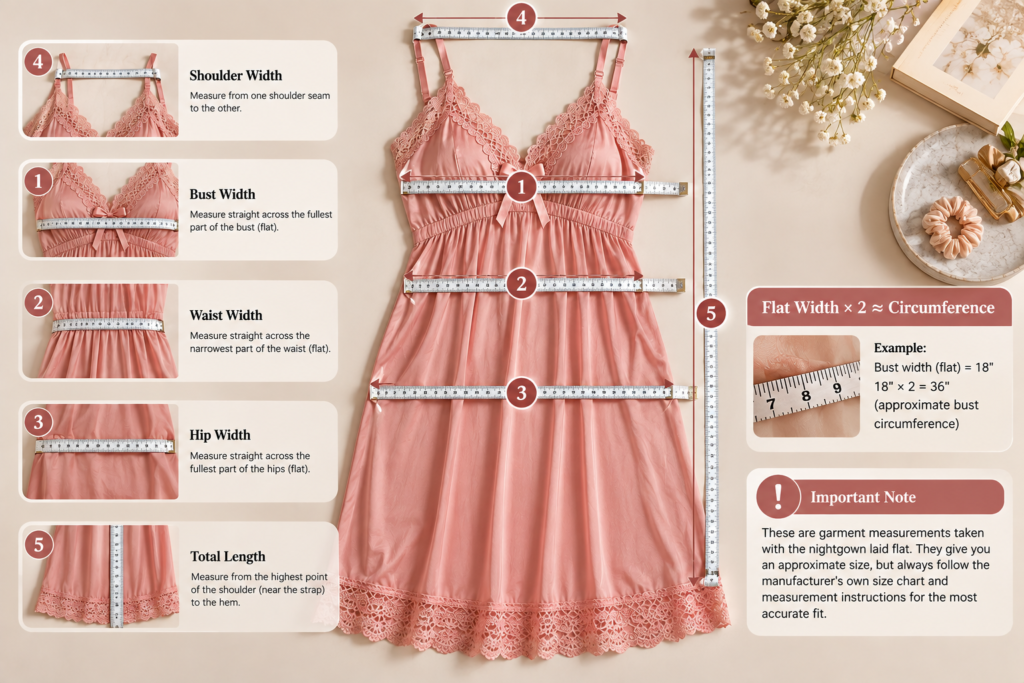
For example, if the nightgown measures 21 inches across the bust when laid flat, its approximate bust circumference is 42 inches.
But be careful.
This method works best when comparing garments made with similar construction and fit.
A stretchy knit and a rigid woven garment can produce very different experiences even when their flat measurements look similar.
How to Measure for a Plus-Size Nightgown
The process doesn’t change.
Measure:
- Bust
- Waist
- Hips
- Length
Then use the brand’s plus-size chart if one exists.
Don’t assume that a plus-size garment follows the same proportions as a straight-size garment scaled upward.
Different brands use different blocks and fit models.
Look specifically for:
- Bust ease
- Armhole room
- Hip room
- Garment length
- Sleeve circumference
- Stretch percentage if provided
A well-designed plus-size nightgown should account for more than simply increasing the circumference.
How to Measure for a Petite Nightgown
Petite shoppers often face a different issue: length and proportion.
You may find that your bust, waist, and hips correspond to one standard size, but the garment itself feels too long.
Pay particular attention to:
- Overall length
- Shoulder placement
- Armhole position
- Sleeve length
- Bust placement
If a brand offers petite lengths, compare those measurements rather than automatically sizing down.
Sizing down changes circumference.
It doesn’t necessarily solve proportion.
How to Measure for a Tall Nightgown
Tall shoppers should pay close attention to garment length and sleeve length.
A nightgown can fit perfectly around the bust and hips and still finish much higher than intended.
Look for product-specific length measurements whenever possible.
If the retailer gives the model’s height and the garment length, use those details together rather than relying solely on the product photo.
Nightgown Size Chart: Don’t Assume S, M, and L Mean the Same Thing
An S from one brand isn’t guaranteed to match an S from another.
Even within the same brand, different garment styles can use different fits.
That’s why your actual measurements matter more than your usual letter size.
Better shopping sequence
Measure yourself → open the size chart → identify body vs garment measurements → check fit → check fabric/stretch → choose the size.
Not:
“I usually wear medium, so I’ll buy medium.”
Common Nightgown Measurement Mistakes
Measuring over bulky clothes
This can add unnecessary inches.
Pulling the tape tight
This produces artificially small measurements.
Letting the tape slope
Keep the tape level around your body.
Measuring your waist where your pants sit
Your natural waist may be higher.
Ignoring your hips
Long or fitted nightgowns may need more room through the lower body.
Ignoring garment length
A correct circumference doesn’t guarantee a correct length.
Assuming all charts use body measurements
Some product pages show finished garment measurements.
Sizing down for a “better” fit
Smaller isn’t automatically better, especially for sleepwear.
Ignoring fabric stretch
A stretchy jersey and a non-stretch woven fabric won’t behave the same way.
Using another brand’s measurements
Use the size chart for the actual garment you’re buying.
Your 2-Minute Nightgown Measurement Checklist
Before ordering, write down:
Bust: ______
Waist: ______
Hips: ______
Preferred length: ______
Underbust, if needed: ______
Shoulder, if needed: ______
Sleeve length, if needed: ______
Then check:
☐ Is the size chart based on body measurements?
☐ Does the garment have stretch?
☐ Is the fit loose, regular, or fitted?
☐ Does the garment length suit my height?
☐ Does my largest relevant measurement fall within the selected size?
☐ Are there product-specific fit notes?
☐ Have I checked the fabric?
If you can answer all seven, you’re in a much better position to choose the right size.
How to Measure for a Nightgown: The Simple Method
If you only remember one thing from this guide, remember this:
Measure your bust, natural waist, hips, and desired length.
Keep the tape level.
Don’t pull it tight.
Take your measurements over minimal clothing.
Then compare those numbers with the specific brand’s size chart.
If the garment is fitted, pay closer attention to bust, waist, and hip measurements.
If it’s loose and flowing, bust and length may matter more.
If it’s long, check the actual garment length.
If it has sleeves, check sleeve measurements.
And if the fabric stretches, take that into account, but don’t assume stretch makes sizing irrelevant.
Did You Learn How to Measure Yourself For a Nightgown?
Learning how to measure for a nightgown takes only a few minutes, but those measurements can save you from a surprisingly frustrating purchase.
The trick isn’t getting a perfect number down to the last fraction of an inch.
It’s taking consistent measurements and understanding what those measurements mean for the garment you’re buying.
Your bust tells you how the upper body may fit.
Your waist tells you whether a defined middle will feel comfortable.
Your hips tell you whether the lower body has enough room.
Your length measurement tells you where the hem is likely to fall.
Then fabric, stretch, construction, and intended fit complete the picture.
A nightgown should give you room to move, not make you spend the night adjusting it.
So measure first.
Check the chart second.
Then choose the garment.
Frequently Asked Questions
What measurements do I need for a nightgown?
Most nightgowns require your bust, waist, and hip measurements. You should also check garment length, especially when buying long, petite, or tall styles.
How do I measure my bust for a nightgown?
Wrap a flexible tape around the fullest part of your bust while keeping it level and comfortably snug. Don’t pull the tape tight.
How do I measure my waist for a nightgown?
Find your natural waist by bending slightly to one side, then measure around that point while standing normally. Keep the tape snug but not tight.
How do I measure my hips for a nightgown?
Measure around the fullest part of your hips and seat while keeping the tape horizontal.
Should I measure myself over clothes?
For the most consistent result, use minimal clothing or lightweight, close-fitting undergarments. Bulky clothing can add extra circumference.
Should a nightgown be loose or fitted?
That depends on the style and your preference. Loose nightgowns generally provide more room for movement, while fitted styles follow the body more closely. Check the product’s stated fit before choosing a size.
What if my measurements fall between two sizes?
Check the garment’s fit, fabric, and size chart before choosing. For fitted or non-stretch styles, pay particular attention to the largest relevant body measurement rather than automatically sizing down.
Should I size up for a nightgown?
Not automatically. If you want a relaxed fit, first look for a garment designed as relaxed or loose rather than simply buying a larger size.
How do I measure nightgown length?
Decide where you want the hem to fall, then compare that desired length with the garment length provided by the retailer. Comparing it with a nightgown or dress you already own can make the measurement easier to visualize.
Do nightgown measurements include ease?
Body measurements and garment measurements are different. A relaxed nightgown will usually have additional room, or ease, beyond your body measurements. Always check whether the retailer’s chart refers to your body or the finished garment.
Does fabric affect nightgown sizing?
Yes. Stretch, fabric weight, construction, and drape can change how a garment fits. A stretchy knit can behave very differently from a non-stretch woven fabric even when the listed size is identical.
Are nightgown sizes standardized?
No. Letter sizes such as S, M, and L can vary between brands and styles. Your measurements and the specific product’s size chart are more reliable than assuming your usual letter size will always fit.
How do I measure for a plus-size nightgown?
Use the same core measurements—bust, waist, hips, and length—but check the brand’s dedicated plus-size chart and fit information. Don’t assume a standard-size garment simply scales proportionally into plus sizes.
How do I measure for a petite nightgown?
Take your normal body measurements, then pay particular attention to garment length, shoulder placement, sleeve length, and bust placement. A petite size changes proportions, not just circumference.
Leave a Reply