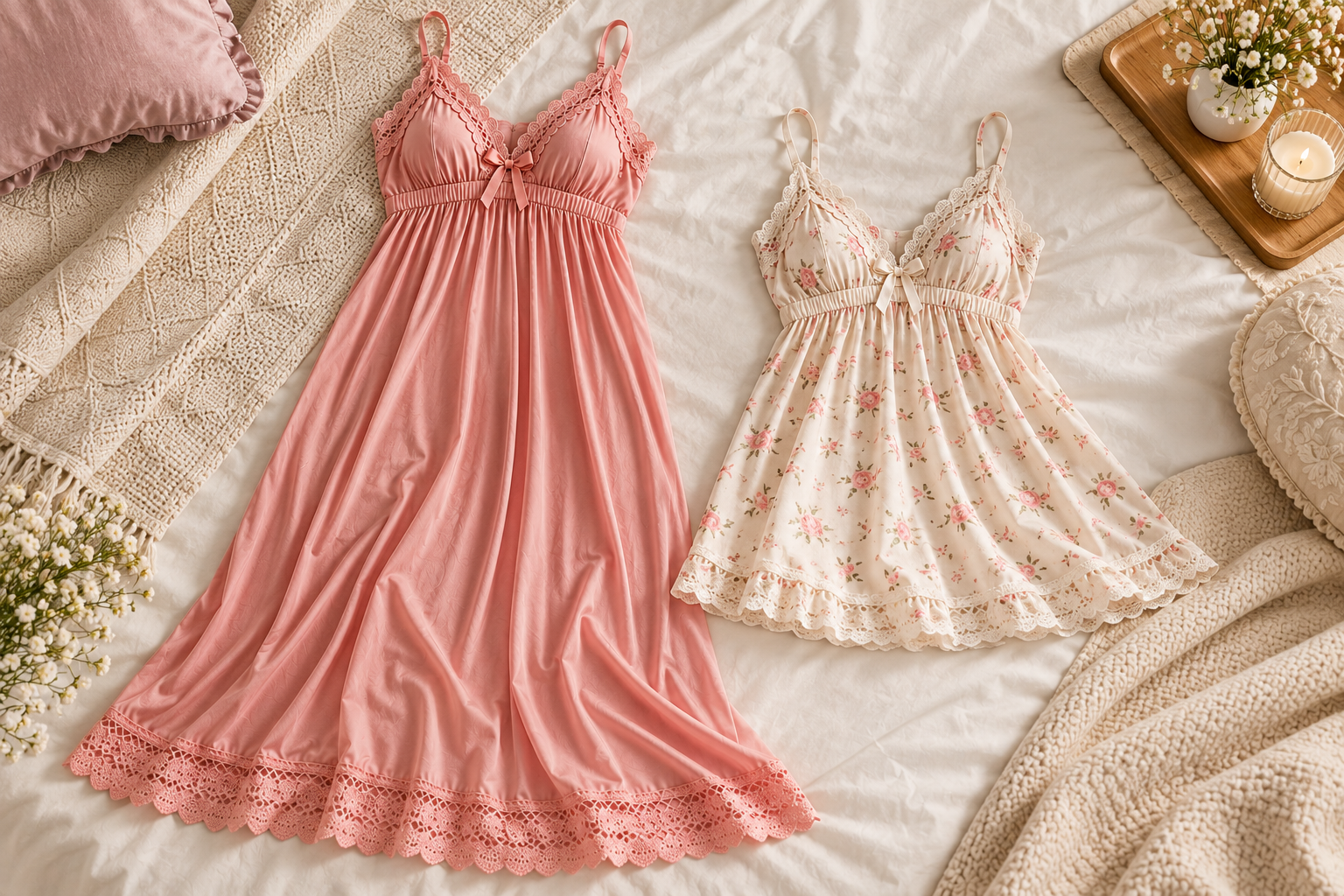
Nightgown and nightdress often describe the same basic thing: a one-piece garment designed for sleeping or relaxing.
The difference usually comes down to language, region, tradition, and how a retailer chooses to name the garment rather than a strict technical rule.
In American English, nightgown is the more familiar term. In British English and some other varieties of English, nightdress is more common. But you can find short nightgowns, long nightdresses, loose nightdresses, fitted nightgowns, and everything in between.
So if you are searching for the difference between a nightgown vs nightdress, do not rely on the name alone.
Look at the length, silhouette, fabric, construction, fit, and intended use.
That approach gives you a much more useful answer—especially when shopping online.
Nightgown vs Nightdress: The Short Answer
A nightgown and a nightdress are generally the same broad category of one-piece sleepwear.
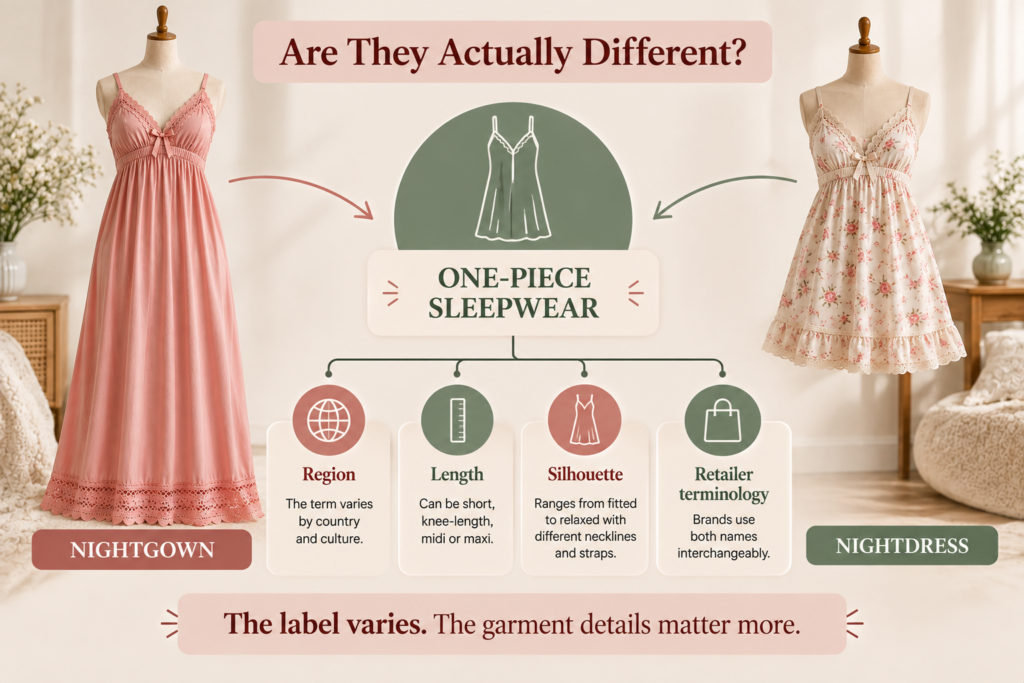
The terminology varies more reliably than the garment itself.
| Feature | Nightgown | Nightdress |
|---|---|---|
| Basic construction | One-piece sleepwear | One-piece sleepwear |
| Typical use | Sleeping and lounging | Sleeping and lounging |
| Length | Short to full length | Short to full length |
| Fit | Relaxed, flowing, fitted, or shaped | Relaxed, flowing, fitted, or shaped |
| Fabric | Cotton, modal, satin, silk, jersey, blends, etc. | Cotton, modal, satin, silk, jersey, blends, etc. |
| Regional usage | Especially common in American English | Especially common in British English |
| Is the name a strict definition? | No | No |
Current sleepwear guides also treat nightdress, nightgown, and nightie as overlapping terms for one-piece nightwear, with differences often coming from length, style, and regional naming.
So the simplest answer is:
A nightgown and a nightdress usually refer to the same type of garment. The name does not reliably tell you how long, fitted, or formal the garment will be.
Why Do We Have Two Names for the Same Type of Sleepwear?
The confusion largely comes from English-speaking regions developing different everyday vocabulary.
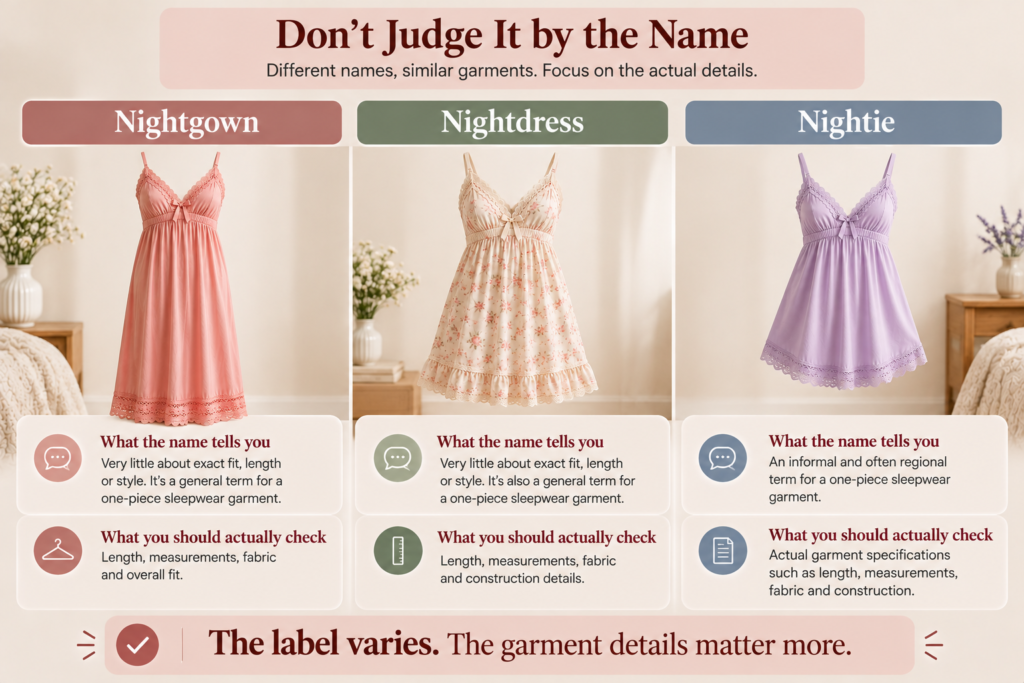
Nightgown is particularly common in American English.
Nightdress is especially common in British English and appears widely across other markets influenced by British English.
That does not mean every American retailer uses nightgown or every British retailer uses nightdress. Clothing retailers frequently use both terms because shoppers search for both.
And modern ecommerce makes the overlap even greater.
A retailer might call one product a “long nightdress,” while another retailer sells a nearly identical garment as a “full-length nightgown.”
The product itself may have no meaningful technical difference.
Is a Nightgown Longer Than a Nightdress?
Not necessarily.
This is one of the most common claims in comparison articles, but it creates a false rule.
Some retailers use nightgown for longer, flowing garments and nightdress for shorter designs. You can certainly find that pattern.
But it is not a universal definition.
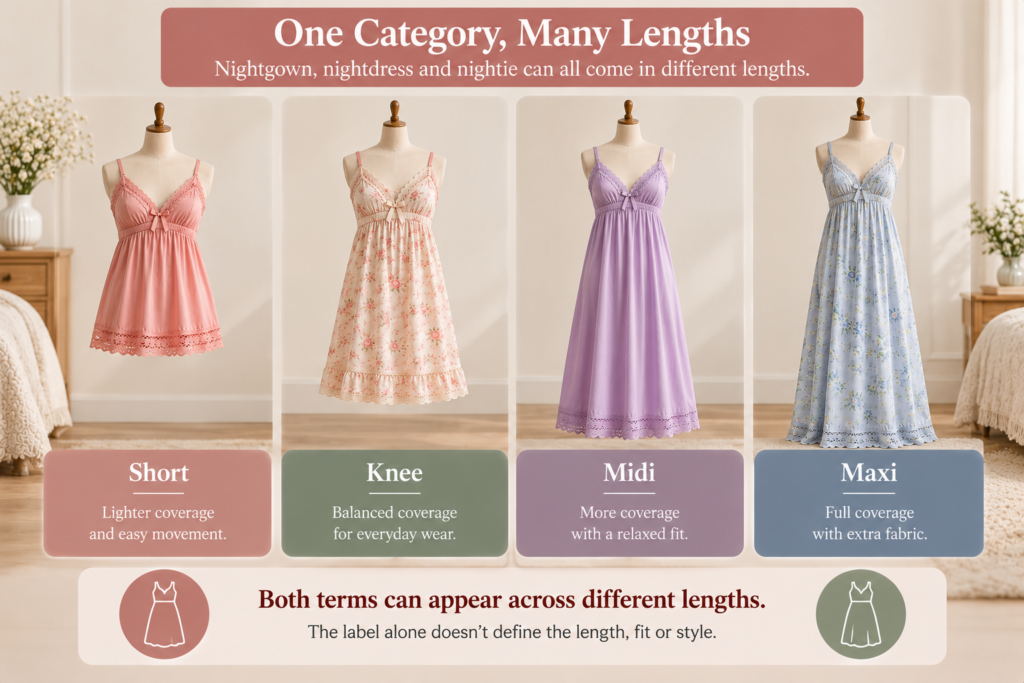
A nightgown can be short.
A nightdress can be ankle length.
Both can have sleeves, straps, lace, a loose silhouette, or a more shaped bodice.
Modern sleepwear sources describe nightdresses as one-piece garments that can range from mid-thigh to ankle length, while broader definitions of nightgowns also cover a wide range of lengths.
Treat length as a garment feature, not a vocabulary rule.
If length matters to you, check the actual garment measurement.
What Is a Nightgown?
A nightgown is a one-piece garment designed primarily for sleeping, lounging, or relaxing at home.
The silhouette can vary enormously.
You might find:
- Short nightgowns
- Knee-length nightgowns
- Midi-length styles
- Ankle-length gowns
- Full-length gowns
- A-line gowns
- Empire-waist gowns
- Slip-style gowns
- Sleeveless gowns
- Short-sleeve gowns
- Long-sleeve gowns
- Relaxed oversized designs
Traditional designs often emphasize a flowing silhouette and comfortable movement, but modern nightgowns can look much more varied.
The word therefore describes a category, not one fixed pattern.
If you want to understand how a nightgown differs from a nightie or nightshirt, read Nightgown vs Nightie vs Nightshirt: What’s the Difference?.
What Is a Nightdress?
A nightdress is also a one-piece sleepwear garment.
The name is especially common in British English, but you will see it across international ecommerce stores as well.
A nightdress can be:
- Loose or fitted
- Short or long
- Sleeveless or sleeved
- Plain or decorative
- Cotton or silky
- Minimalist or lace-trimmed
That means “nightdress” does not automatically tell you what the garment will look like.
The product specifications matter more.
For example, one retailer might use “nightdress” for a loose cotton sleep dress, while another uses the term for a short satin design.
Nightgown vs Nightdress: What Actually Changes?
If the names overlap, what should you compare?
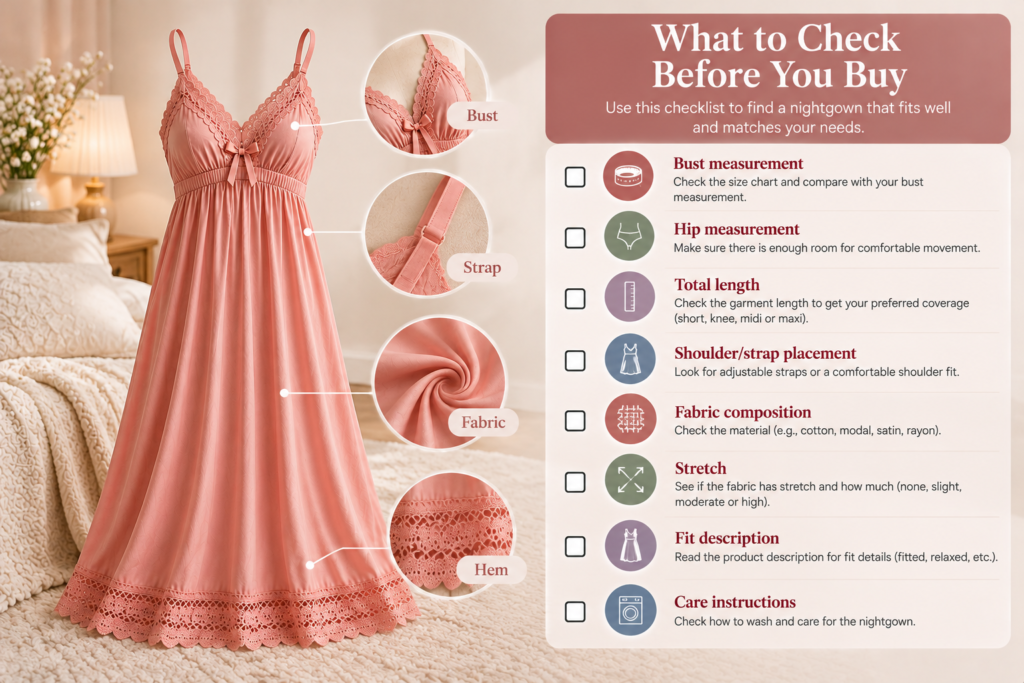
Four things matter much more than the label:
1. Construction
Look at how the garment is built.
Does it have a defined waist?
Is the bust shaped?
Does it fall straight from the shoulders?
Does it flare from an empire seam?
Does it use adjustable straps?
Construction tells you more about fit and movement than the word gown or dress.
2. Length
Check the actual finished length.
A product title might say “long nightdress,” but you still need the measurement to know where the hem will fall on your body.
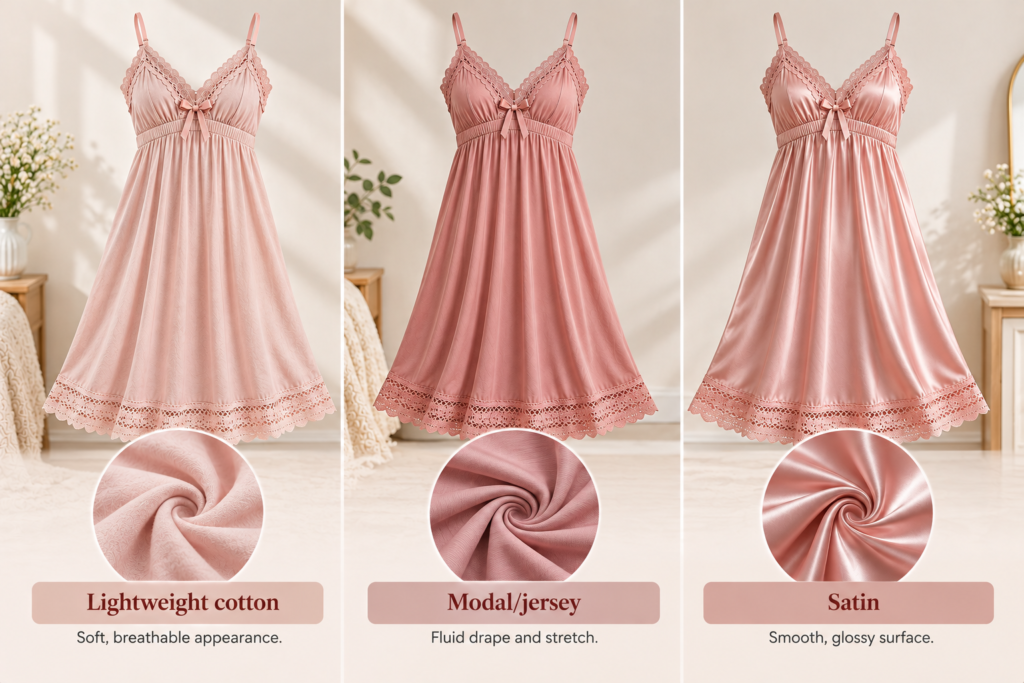
3. Fabric
Cotton jersey, woven cotton, satin, silk, modal, and synthetic blends can produce completely different experiences even when two garments have identical dimensions.
4. Intended use
Ask what you want the garment to do.
Do you want something cool for summer?
Something warm for winter?
Something loose for sleeping?
Something elegant for a bridal trousseau?
Something comfortable enough for lounging during the morning?
Those questions will narrow your choice faster than the product name.
Nightgown vs Nightdress: Which One Is More Comfortable?
Neither one automatically wins.
Comfort comes from fit + fabric + construction + personal preference.
A loose cotton nightdress may feel cooler than a long satin nightgown.
But a lightweight long nightgown may feel more comfortable for someone who prefers additional coverage.
A fitted nightdress might work well for someone who dislikes excess fabric.
Another person may find that same silhouette restrictive while sleeping.
This is why the best choice depends on how you actually use your sleepwear.
Which Is Better for Hot Weather?
For hot weather, focus on the fabric, weight, breathability, and amount of coverage rather than whether the label says nightgown or nightdress.
A short, lightweight cotton nightgown can be cooler than a heavy, full-length nightdress.
Likewise, a lightweight long nightdress can feel comfortable in warm weather if the fabric allows airflow and the design does not trap unnecessary heat.
Look for:
- Lightweight construction
- Breathable fabrics
- Relaxed fit
- Less restrictive waist construction
- Appropriate coverage
- A silhouette that allows air to move
For a deeper look at fabric choices, see What Are Sleepwear Fabrics?.
You can also explore Lingerie Fabrics: The Complete Guide for a broader explanation of fibers, fabric construction, stretch, and surface feel.
Which Is Better for Cold Weather?
Again, the name does not decide this.
A long, full-coverage nightgown can work well in cooler conditions, particularly when made from a suitable fabric.
But length alone does not guarantee warmth.
Fabric weight, sleeve coverage, layering, and room temperature all matter.
A lightweight ankle-length nightdress may provide less warmth than a shorter flannel sleep dress.
If you sleep cold, think about coverage and fabric together.
If you sleep warm, avoid choosing a long garment simply because you assume longer means better.
Nightgown vs Nightdress for Sleeping
When sleep is the priority, focus on movement.
A garment should allow you to:
- Turn in bed
- Bend your knees
- Sit down
- Get out of bed
- Raise your arms
- Stretch
- Walk comfortably
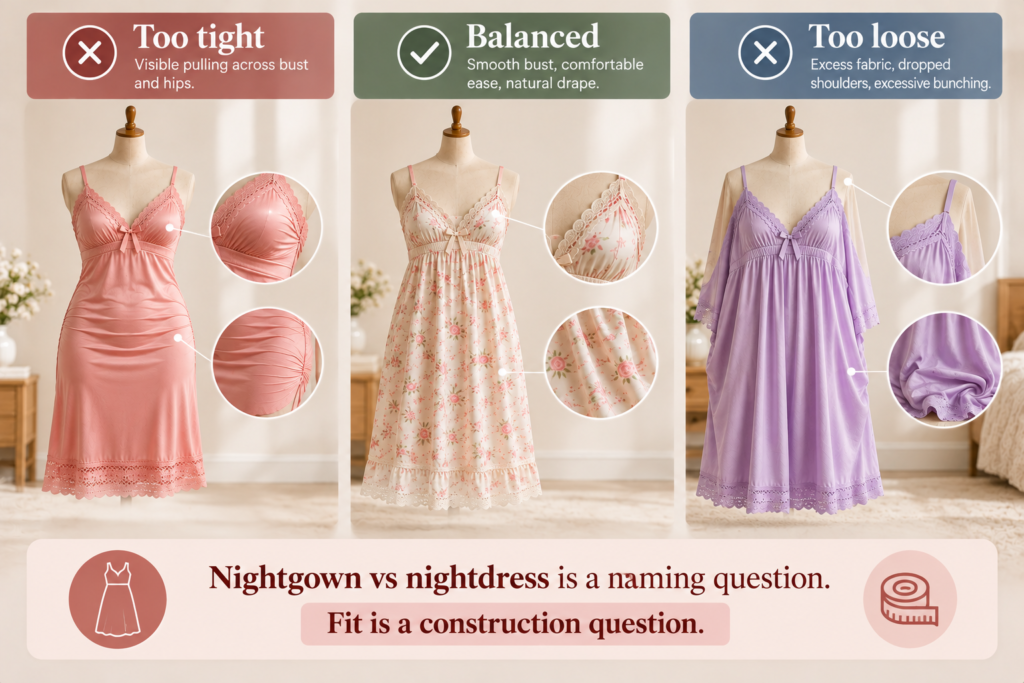
A gown that looks beautiful while standing can become irritating if it twists around your legs or pulls across your hips when you move.
This is why the right sleepwear fit should not be judged only in front of a mirror.
Your body moves during sleep.
Your clothing should move with it.
For a deeper guide, read How Should a Nightgown Fit?.
What Should You Look for in Nightgown Measurements?
If you are shopping online, nightgown measurements can tell you much more than the product name.
Start with:
- Bust
- Waist
- Hips
- Shoulder width
- Total length
- Sleeve length, if applicable
- Strap length or adjustability, if applicable
The measurements you need depend on the garment.
A loose A-line gown may not require the same level of hip precision as a fitted slip-style design.
A long gown makes total length especially important.
A sleeved gown requires more attention to shoulders and arm movement.
And a fitted bust needs more accurate chest measurements.
If you need help taking your measurements, use our guide to How to Measure Yourself for a Nightgown.
Body Measurements vs. Garment Measurements
This is one of the most important things to understand when buying either a nightgown or nightdress online.
Your body measurement tells you the size of your body.
A garment measurement tells you the size of the finished garment.
They should not necessarily be identical.
If your bust measures 38 inches, you should not assume you need a nightgown that measures exactly 38 inches around the bust.
The garment needs appropriate ease.
That extra room allows your body to move.
Body measurements
These may include:
- Bust
- Waist
- Hips
- Height
- Shoulder
- Underbust
Garment measurements
These may include:
- Bust width
- Waist width
- Hip width
- Shoulder width
- Total length
- Sleeve length
- Hem width
Always check whether a retailer gives a flat garment measurement or a full circumference before comparing the number with your body measurement.
For more help, see our guide to How Should a Nightgown Fit?.
Does a Nightgown or Nightdress Need to Be Loose?
Not always.
Relaxed sleepwear often gives you more freedom of movement, but some people prefer a closer silhouette.
The key is to avoid confusing fitted with tight.
A fitted nightdress can follow the body while still allowing comfortable movement.
A relaxed nightgown can provide more space without looking oversized.
The best fit depends on:
- Your sleeping position
- Your body proportions
- Fabric stretch
- Garment construction
- Desired coverage
- Personal preference
For most sleep-focused designs, you want enough ease that the garment does not pull when you move.
Nightgown vs Nightdress vs Nightie
This is where the terminology becomes even more confusing.
Nightie is commonly used as an informal term for sleepwear, particularly in British English and other markets.
Depending on the region, a nightie can describe a shorter one-piece sleep garment or function as a broader casual term for nightwear.
So you can think of the three terms like this:
Nightgown: Common category name, especially in American English.
Nightdress: Another category name, especially common in British English.
Nightie: Informal term that can refer to a nightdress or other one-piece sleepwear.
But do not turn these into rigid definitions.
Retailers use these terms inconsistently.
And regional language can change what shoppers expect from each word.
If you want the detailed three-way comparison, read Nightgown vs Nightie vs Nightshirt.
What Is a Nightie?
A nightie is generally an informal name for a garment worn to sleep.
Depending on where you live, it can mean a short nightdress, a loose sleep dress, or a broader category of one-piece nightwear.
The word also has different cultural meanings in different markets.
That is why shoppers should look at the actual product description and measurements instead of assuming the word nightie means one specific length or style.
For a dedicated explanation, read What Is a Nightie?.
Nightgown vs Nightdress vs Pajama Set
The biggest practical difference appears when you compare either one-piece style with pajamas.
A nightgown or nightdress uses one continuous garment.
A pajama set separates the top and bottom.
That changes how the garments move and how you fit them.
One-piece sleepwear
Advantages:
- No waistband
- Simple to put on
- Easy one-piece construction
- Can provide flowing movement
- Often works well for people who dislike separate bottoms
Pajama sets
Advantages:
- Separate fit for top and bottom
- More leg coverage
- Easier to layer
- More secure coverage for active sleepers
- Wide range of cuts
Neither is universally better.
Your sleeping habits decide more than the category name.
Read Nightgown vs Pajama Set: Which Is Better for Sleep? for a deeper comparison.
What About Satin Nightgowns and Nightdresses?
Satin creates another source of confusion.
People sometimes assume that satin automatically means a garment belongs to a particular category.
It does not.
Satin describes a fabric construction, not whether the garment is a nightgown or nightdress.
You can have:
- Satin nightgowns
- Satin nightdresses
- Satin slips
- Satin pajama sets
- Satin robes
And not all satin feels the same.
“Satin” also does not automatically mean silk. Satin can use different fibers, including synthetic fibers.
So check the actual fiber composition rather than relying on the word satin.
What About Lace Nightgowns and Nightdresses?
Lace is another design feature rather than a category.
A lace-trimmed garment can be:
- A nightgown
- A nightdress
- A chemise
- A slip
- Part of a larger sleepwear set
When shopping, look beyond the lace.
Check:
- Where the lace sits
- Whether it touches sensitive skin
- Whether the garment is lined
- Whether the main fabric stretches
- Whether the lace creates additional structure
- Whether the garment is intended primarily for sleep or appearance
This becomes especially important if you are sensitive to texture.
Nightgown vs Nightdress for Different Body Types
There is no body type that requires one particular term.
Instead, choose the silhouette that gives you the right balance of room and structure.
Fuller bust
Look for enough bust ease and comfortable shoulder placement.
An adjustable strap or shaped bodice can help.
Fuller hips
An A-line or flared design can give you useful room without making the entire garment oversized.
Petite proportions
Pay close attention to total length, strap placement, and shoulder width.
Sizing up simply to gain length can make the upper body unnecessarily large.
Tall proportions
Check the actual garment length.
A larger size may increase width without giving you the proportional length you need.
Straight body proportions
You can experiment with both relaxed and shaped designs.
Empire seams, gentle waist shaping, or flowing silhouettes can change how the garment sits without requiring a tight fit.
Can a Nightgown or Nightdress Be Worn Outside the Bedroom?
Sometimes.
Modern fashion frequently borrows sleepwear-inspired silhouettes, particularly slip dresses and flowing dress shapes.
But a garment designed for sleeping and one designed for public wear can behave differently.
If you plan to wear a sleepwear-inspired garment outside, consider:
- Opacity
- Coverage
- Fabric weight
- Construction
- Strap security
- Hem length
- Overall styling
Do not assume that a garment called a “nightdress” is automatically unsuitable for daytime wear.
Likewise, a “nightgown” can sometimes look more like a conventional dress than traditional sleepwear.
The product’s actual construction tells you more.
How to Choose Between a Nightgown and Nightdress
Instead of asking “Which name is better?”, ask these questions:
Do you want more or less coverage?
Choose the length and construction that give you the coverage you actually want.
Do you sleep hot or cold?
Choose fabric weight and breathability accordingly.
Do you move around a lot?
Prioritize ease and a silhouette that will not catch around your legs.
Do you dislike waistbands?
A one-piece nightgown or nightdress may be more comfortable than pajamas.
Do you prefer a closer silhouette?
Look for a fitted or gently shaped design.
Do you want maximum freedom?
Choose a relaxed or flowing design with enough ease.
Are you buying online?
Prioritize nightgown measurements, garment length, fabric composition, and the brand’s size chart over the product name.
A Better Way to Shop: Ignore the Name First
This is probably the most useful takeaway from the entire comparison.
When you see:
“Nightgown”
or
“Nightdress”
do not make your decision yet.
Open the product details.
Check:
1. Length
Where will the hem actually fall?
2. Bust measurement
Will you have enough room?
3. Hip measurement
Can you sit and turn comfortably?
4. Shoulder or strap placement
Will the upper body stay where it should?
5. Fabric composition
Will it feel appropriate for your sleeping environment?
6. Stretch
Does the fabric have enough give?
7. Fit description
Is it fitted, regular, relaxed, or oversized?
8. Care instructions
Could washing change the fit?
This approach works far better than assuming “nightgown = long” or “nightdress = short.”
Nightgown vs Nightdress: What Should You Actually Buy?
If you want a simple answer, buy the garment whose construction matches your sleeping needs, regardless of the name.
Choose a nightgown if you find a silhouette, length, and fabric that suit you.
Choose a nightdress if you find a silhouette, length, and fabric that suit you.
The terminology should not make the decision for you.
For most shoppers, the more useful comparison is:
How does it fit?
How much coverage does it provide?
What fabric is it made from?
How much room does it give you?
And will it stay comfortable when you actually sleep in it?
Those answers tell you far more than the label.
Frequently Asked Questions
Is a nightgown the same as a nightdress?
Generally, yes. Both terms describe a one-piece garment intended for sleeping or relaxing. Regional usage differs, with nightgown particularly common in American English and nightdress particularly common in British English. Retailers may use the terms differently.
Is a nightdress shorter than a nightgown?
Not as a strict rule. Some retailers use nightdress for shorter styles and nightgown for longer ones, but both terms can describe garments across a wide range of lengths.
Which is more comfortable, a nightgown or nightdress?
Neither is automatically more comfortable. Comfort depends on fit, fabric, construction, length, and personal preference.
Is a nightdress the same as a nightie?
They can refer to the same type of garment. Nightie is generally a more informal term, while nightdress sounds more like a formal garment category.
What is the difference between a nightgown and a nightie?
The terms overlap heavily. A nightie is an informal term for one-piece sleepwear, while nightgown is a more standard category name in some English-speaking markets. The actual garment can look very similar.
Is a nightgown supposed to be loose?
Many nightgowns use a relaxed fit because sleepwear needs room for movement. However, some modern nightgowns use a closer or shaped silhouette. The garment should feel comfortable without restricting movement.
What measurements should I check when buying a nightgown?
Check bust, waist, hips, shoulder width, and total length where available. Sleeve length or strap measurements can also matter depending on the design.
Does nightgown length matter for sleep?
Yes. Length affects coverage, movement, temperature, and how much fabric you have around your legs. Choose based on your sleeping habits rather than assuming longer or shorter is automatically better.
Can I wear a nightdress during the day?
Some can work as sleepwear-inspired daytime clothing, particularly slip-style or dress-like designs. Check opacity, coverage, fabric, and overall construction before wearing one outside.
Are nightgowns and nightdresses good for hot weather?
They can be. Choose lightweight, breathable fabrics and a relaxed design if you sleep hot. The term itself does not determine whether a garment will feel cool.
Is a satin nightgown made from silk?
Not necessarily. Satin describes a type of fabric construction and can use different fibers. Check the product’s fiber composition to determine whether it contains silk.
How should a nightgown fit?
A nightgown should provide enough room for comfortable movement without excessive fabric that twists or bunches. Check the bust, shoulders, hips, length, and overall ease.
Leave a Reply