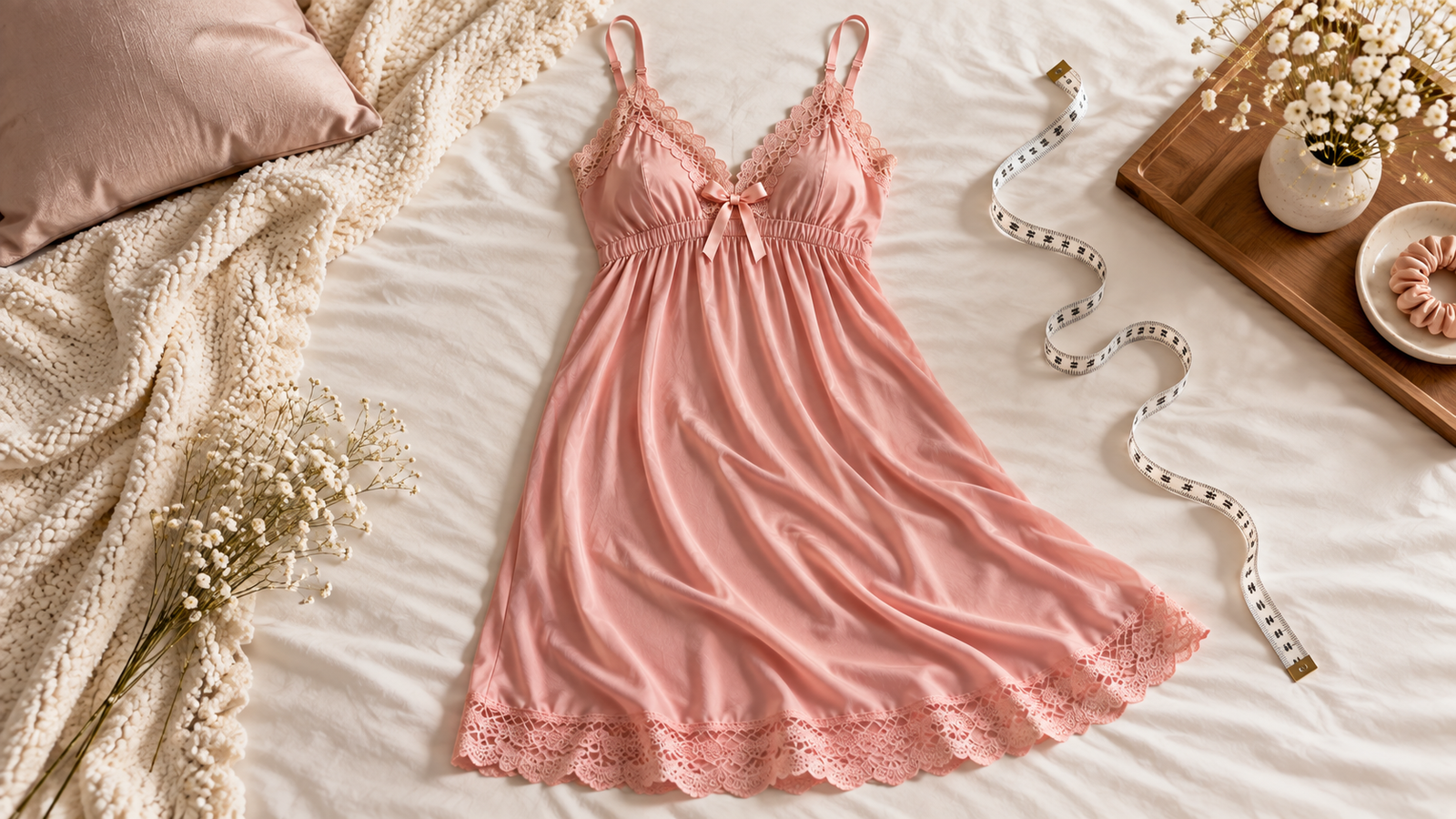
A nightgown should feel relaxed, comfortable, and easy to move in without looking excessively oversized. It should skim your body rather than cling to it, give your bust and hips enough room to move, sit comfortably at the shoulders, and stay in a practical position when you sit, walk, turn, or lie down.
The right nightgown fit depends on more than your usual clothing size. Bust, waist, hips, shoulder placement, garment length, fabric, cut, and the amount of ease built into the design all affect how a nightgown feels once you actually wear it.
And there is an important difference between a nightgown that fits while you are standing and one that works throughout the night.
A gown can look perfect in a mirror but pull across your shoulders when you reach for something, ride up when you turn in bed, or feel restrictive around your hips when you sit down.
So, how should a nightgown fit? Start with this rule:
It should give your body enough room to move without creating so much excess fabric that the gown twists, bunches, or constantly shifts.
If you are still figuring out your measurements, start with our guide to how to measure yourself for a nightgown.
What Does a Well-Fitting Nightgown Look Like?
A well-fitting nightgown usually follows the natural shape of your body without trying to hold it tightly.
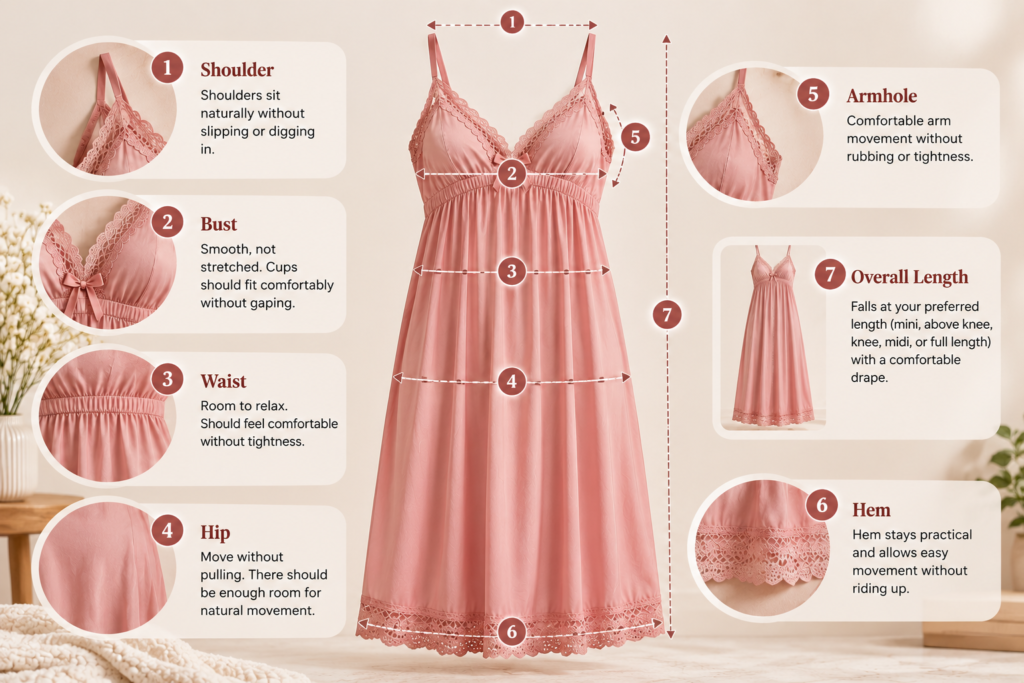
The exact appearance changes with the style. An A-line nightgown can look quite loose through the hips. A fitted bodice may sit closer around the bust. An oversized nightshirt may intentionally have more fabric through the body.
The goal is not to make every nightgown look the same.
The goal is to make sure the garment’s intended shape works with your body and the way you sleep.
| Area | A good fit | Signs it is too small | Signs it is too large |
|---|---|---|---|
| Shoulders | Seams sit naturally without pulling | Seams pull inward or restrict movement | Seams drop far down the arm |
| Bust | Smooth without stretching or gaping | Fabric pulls, buttons strain, neckline shifts | Excess fabric or major gaping |
| Waist | Comfortable and unrestricted | Clings or feels compressed | Excess fabric constantly gathers |
| Hips | Enough room to sit and turn | Fabric catches or rides upward | Large amounts of fabric bunch |
| Armholes | Allow natural arm movement | Dig into underarms | Drop excessively |
| Length | Falls where intended | Feels short or rides up excessively | Trips, tangles, or feels cumbersome |
| Hem | Moves naturally with you | Restricts your stride | Swings or catches underfoot |
There is no universal measurement that defines the perfect nightgown. Clothing brands use their own size charts and fit specifications, which is why your body measurements should always be compared with the specific garment’s chart rather than relying only on S, M, L, or XL. Major apparel brands similarly base sizing on measurements such as bust/chest, waist, and hips rather than the letter size alone.
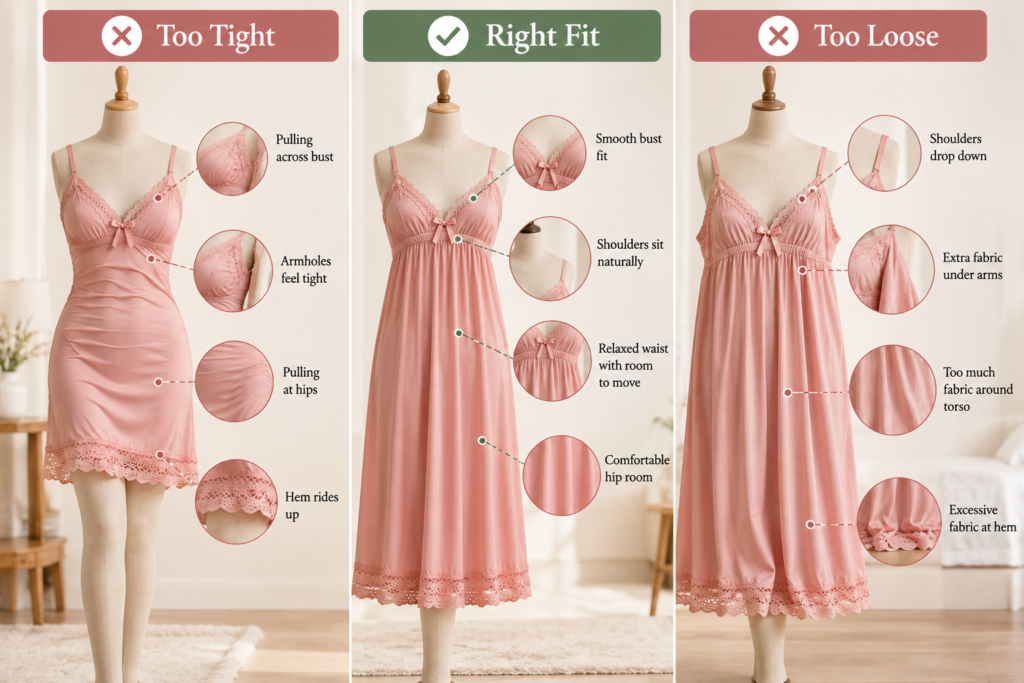
The Most Important Rule: Fit It for Movement
Sleepwear has a different job from fitted daytime clothing.
You are not standing still in a nightgown for most of the time you wear it. You sit, bend, stretch, roll over, get out of bed, walk around, and sometimes sleep in several different positions during the same night.
That means a gown that looks slightly loose when you stand may actually be the better fit.
Try these movements before deciding
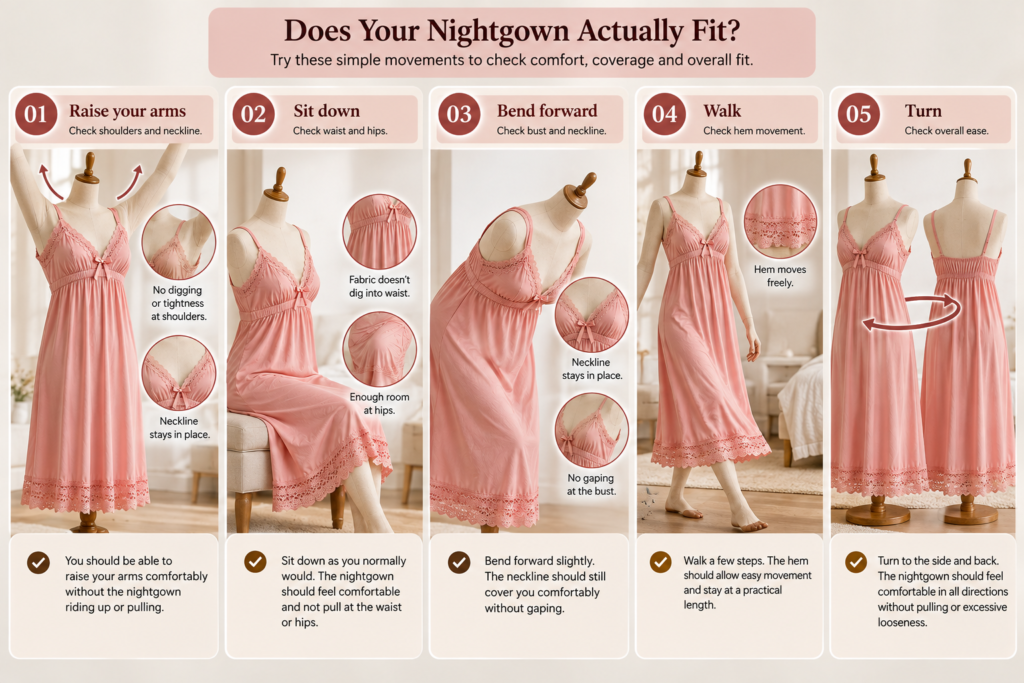
If you can try the nightgown on, perform a simple movement test:
- Raise both arms.
- Reach forward.
- Sit down.
- Bend slightly.
- Walk several steps.
- Turn your torso from side to side.
- Lie down if the fitting environment allows it.
- Mimic turning from one sleeping side to the other.
Watch what happens to the fabric.
If the neckline pulls, the armholes dig in, the bust stretches, or the hips become tight when you move, the gown needs more room or a different cut.
And if the gown produces a huge amount of fabric that twists around your body with every movement, you may have gone too far in the opposite direction.
How Should a Nightgown Fit Around the Bust?
The bust is one of the first places to check because a poorly fitted upper body can affect the entire garment.
The fabric should lie smoothly across your chest without creating obvious horizontal pulling lines. Your neckline should remain comfortable when you move rather than constantly shifting upward or pulling toward the back.
A nightgown does not need to fit closely around the bust.
In fact, many relaxed nightgowns intentionally provide additional room here.
Your bust fit is probably too tight if:
- The fabric stretches noticeably across your chest.
- The neckline pulls when you raise your arms.
- Arm movement feels restricted.
- Seams strain around the fullest part of your bust.
- The gown keeps moving upward as you walk.
- You feel pressure across your chest when sitting or lying down.
Your bust fit may be too loose if:
- The neckline constantly falls away from your body.
- There is substantial excess fabric under the arms.
- The shoulder seams fall much farther down your arms than intended.
- The upper body shifts excessively whenever you move.
If your bust measurement puts you between two sizes, check the garment’s cut before automatically choosing the larger size. A loose A-line gown and a fitted nightgown will not use the same amount of fabric around the body.
How Should a Nightgown Fit Around the Waist?
This is where nightgowns have a major advantage over many other types of sleepwear.
You generally do not want a nightgown to feel like shapewear.
The waist should allow your abdomen to relax naturally. You should be able to sit, bend, and lie down without feeling that the garment is holding your middle in place.
A fitted waist can work in some designs, but the construction should match the purpose of the garment.
For everyday sleep, comfort usually wins.
A good waist fit should:
- Feel comfortable when sitting.
- Avoid digging into your stomach.
- Allow natural breathing and movement.
- Avoid creating a tight horizontal band.
- Let the fabric fall naturally below the waist.
If you want to understand why shapewear and sleepwear should not be evaluated by the same fit rules, see our guide to shapewear vs. compression garments.
How Should a Nightgown Fit Around the Hips?
The hips often determine whether a nightgown actually works when you move.
A gown can feel perfectly comfortable while standing but become restrictive when you sit or roll onto your side.
You need enough fabric to let the garment move over your hips instead of catching against them.
Check your hip fit by sitting down
Stand normally and then sit in a chair.
Look at the hem and side seams.
If the fabric pulls sharply across your hips, the gown is too fitted for the way you intend to use it.
If the gown lifts dramatically every time you sit, the combination of hip width, length, fabric friction, and cut may be causing the problem.
A-line and flared nightgowns naturally provide more room through the lower body, while straight or fitted styles may need more careful sizing.
How Should the Shoulders Fit?
Shoulder fit is easy to overlook because people often focus on bust and waist measurements.
But shoulders control how the upper half of the nightgown hangs.
The shoulder seams should sit close to where the garment designer intended them to sit. They should not pull toward your neck when you move your arms.
Raise both arms above your head.
If the entire gown moves upward because the shoulders or armholes restrict your movement, you probably need a different size or construction.
For sleeveless nightgowns
Check the armholes.
They should allow comfortable movement without cutting into the underarm. At the same time, an excessively deep armhole can cause the garment to gape or shift.
For nightgowns with sleeves
Check the sleeve opening and upper arm.
You should be able to bend your arm and move it forward without feeling the sleeve pull against the shoulder seam.
How Long Should a Nightgown Be?
There is no single correct nightgown length.
The best length depends on your height, sleeping habits, bedroom temperature, desired coverage, and the design of the gown.
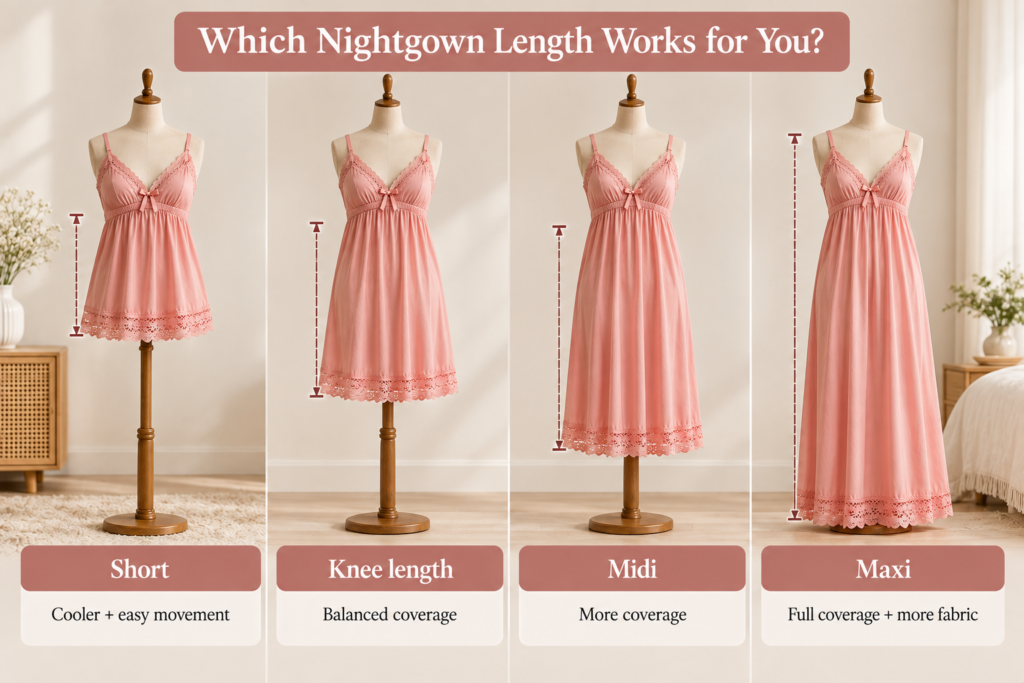
Common options include:
- Short: above or around the upper thigh
- Knee length: practical middle ground
- Midi: more coverage without reaching the ankle
- Maxi: maximum coverage and a more traditional nightgown silhouette
The important part is not the label.
It is what happens when you move.
A short nightgown
A shorter hem can make it easier to walk and may feel cooler in warm weather.
But if the gown becomes uncomfortably short whenever you sit or move, it may not provide the coverage you want.
A knee-length nightgown
This often provides a practical balance between coverage and movement.
It can work well for people who want something longer than a short nightie without dealing with a lot of fabric around the legs.
A long nightgown
A longer gown can provide more coverage and create a flowing silhouette.
But check whether the hem gets under your feet, catches around your legs, or twists when you turn in bed.
Your height also matters. The same labeled length can fall very differently on two people with different proportions.
Nightgown Fit Is About Ease, Not Just Size
One of the most useful concepts to understand is ease.
Ease is the additional room between your body and the garment.
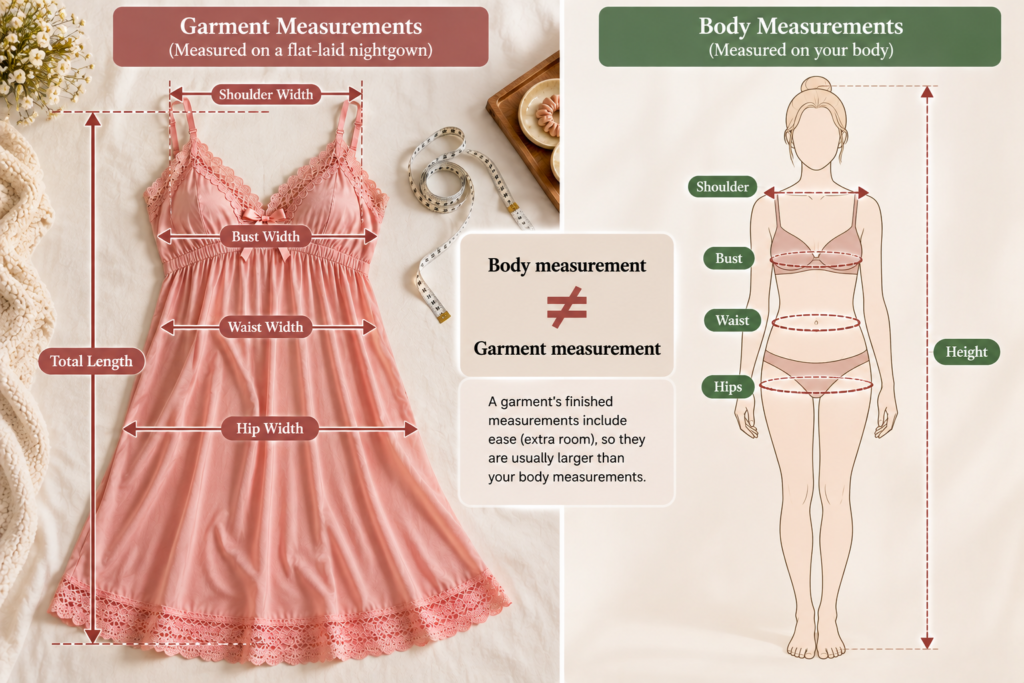
Your body might measure a certain amount around the bust, but that does not mean the nightgown should measure exactly the same amount.
If the garment matched your body measurements exactly, there would be little or no room for movement.
A nightgown therefore needs enough ease for its intended use.
But how much ease should a nightgown have?
There is no universal number.
A loose cotton nightgown, a fitted satin gown, and a stretch-jersey sleep dress can all use different amounts of ease.
Instead of memorizing one formula, think about three questions:
1. How close is the design supposed to fit?
A fitted nightgown needs less visual volume than an oversized nightshirt.
2. How much does the fabric stretch?
Stretch jersey can accommodate movement differently from a rigid woven fabric.
3. How much movement does the design need?
A gown intended for sleeping needs to accommodate more relaxed movement than a decorative garment designed primarily for appearance.
This is why comparing your measurements with the individual brand’s size chart remains more useful than choosing a generic size based on your measurements alone. Apparel brands can assign different body-measurement ranges to the same size label.
Body Measurements vs. Nightgown Measurements
This distinction causes a lot of online-shopping mistakes.
Body measurements describe your body.
Garment measurements describe the finished item.
They are not interchangeable.
For example, if your bust measures 38 inches, you should not automatically look for a nightgown that measures exactly 38 inches across the entire bust area.
The garment needs appropriate ease.
When a retailer gives you both measurements, use them together.
Body measurements usually include:
- Bust or chest
- Natural waist
- Hips
- Height
- Shoulder measurement for some garments
- Sleeve length for sleeved designs
Standard apparel size charts commonly use bust/chest, waist, and hip measurements to determine size, while height and other dimensions can help refine the fit.
Garment measurements may include:
- Bust width
- Waist width
- Hip width
- Shoulder width
- Total length
- Sleeve length
- Armhole
- Hem width
If you are unsure how to take your own numbers, use our detailed guide to nightgown measurements and how to measure yourself for a nightgown.
Which Measurement Should You Prioritize?
Not every nightgown needs the same measurements to fit well.
Your priority should change with the design.
| Nightgown style | Measurements to prioritize |
|---|---|
| Loose nightie | Bust, shoulder, length |
| Fitted nightgown | Bust, waist, hips, length |
| A-line gown | Bust, shoulder, length |
| Empire-waist gown | Bust, underbust/seam placement, length |
| Slip-style gown | Bust, underbust, hips, straps, length |
| Long nightgown | Bust, hips, length |
| Sleeved gown | Bust, shoulder, sleeve, upper arm |
| Oversized nightshirt | Shoulder, bust, length, sleeve |
For example, an A-line gown may give you plenty of room around the hips, so bust and shoulder fit become more important.
A straight-cut gown may require closer attention to hip measurements.
A long gown needs more attention to total length.
And a fitted bodice needs more precise bust and waist measurements.
How Fabric Changes Nightgown Fit
Two nightgowns with identical measurements can feel completely different.
Fabric changes how the garment moves, stretches, drapes, traps heat, and interacts with your skin.
That makes fabric part of the fit decision.
Cotton
Cotton can work well for relaxed nightgowns because many cotton fabrics feel breathable and comfortable against the skin.
The construction still matters, though. A lightweight cotton knit and a structured cotton woven fabric will not behave the same way.
Modal and other soft draping fabrics
Soft, draping fabrics can follow the body more closely without necessarily creating a fitted silhouette.
They often work well when you want a smooth, flowing appearance.
Silk
Silk tends to glide across the body rather than behaving like a rougher, more structured fabric.
That can make the same amount of ease feel different from a cotton garment.
Stretch fabrics
Stretch changes the fitting equation.
A jersey nightgown can accommodate movement differently from a non-stretch woven gown. That does not mean you should buy it tight. Stretch should improve movement, not compensate for an undersized garment.
For a deeper explanation of how fiber, construction, weight, stretch, and surface feel influence sleepwear, see Sleepwear Fabrics: The Complete Guide.
You can also explore our broader guide to lingerie fabrics when comparing materials used across intimate garments.
Your Sleeping Position Can Change the Best Fit
Your preferred sleeping position can influence which fit feels comfortable.
If you sleep on your back
Pay attention to the neckline, shoulder area, and fabric across your back.
A gown that feels fine while standing may feel different once the fabric sits underneath your shoulders.
If you sleep on your side
Check the hip and torso area carefully.
You need enough room for the gown to move as your body changes position without the fabric pulling around your hips.
If you toss and turn
Look for a balanced fit.
Too much fabric can twist around your legs, while too little fabric can catch against your body.
This is one reason the best nightgown fit is rarely the tightest possible fit or the biggest possible size.
Should a Nightgown Be Loose or Fitted?
For most sleep-focused designs, a relaxed or lightly skimming fit works better than a body-hugging fit.
But “loose” does not mean shapeless.
A nightgown can have a defined neckline, structured shoulder, empire seam, fitted bust, or shaped hem while still providing comfortable room through the body.
Think of fit as a spectrum:
Body-hugging → fitted → skimming → relaxed → oversized
Most traditional sleep-focused nightgowns sit somewhere around skimming to relaxed.
The ideal point depends on the design and your personal preference.
If you like a closer silhouette, make sure the fabric and construction still allow you to move freely.
If you prefer maximum airflow and room, choose a relaxed cut without going so oversized that the gown bunches around you.
Signs Your Nightgown Is Too Small
A nightgown is probably too small if several of these problems appear at once:
- The neckline pulls when you move.
- Shoulder seams feel restrictive.
- The bust looks stretched.
- Armholes dig into your underarms.
- You cannot comfortably raise your arms.
- The fabric pulls across your hips when sitting.
- The gown repeatedly rides upward.
- You feel pressure around your waist.
- The hem becomes significantly shorter when you move.
- You constantly adjust the garment during the night.
One isolated issue does not always mean you need a larger size.
The cut could be the problem.
For example, if the bust fits perfectly but the hips feel tight, a different silhouette may work better than simply sizing up.
Signs Your Nightgown Is Too Large
Oversizing can create its own comfort problems.
Look for:
- Shoulder seams dropping far down the arms.
- Excess fabric under the arms.
- A neckline that falls open.
- Fabric twisting around the torso.
- Large folds gathering underneath your body.
- Sleeves constantly sliding.
- A hem that becomes difficult to control.
- Excess fabric catching around your legs.
- The gown shifting every time you turn.
More fabric does not automatically mean more comfort.
The best nightgown gives you useful room, not unlimited fabric.
What If Your Bust, Waist, and Hips Fall Into Different Sizes?
This is completely normal.
Do not assume your body must match one standardized size across every measurement.
Clothing brands can use different size ranges, and your proportions may naturally place you in different size categories for bust, waist, and hips.
Instead, identify the measurement that matters most for the garment.
For a fitted nightgown
Prioritize the largest relevant measurement, usually bust or hips depending on the design.
For an A-line nightgown
Bust and shoulders may matter more because the garment already provides additional room below.
For an empire-waist gown
Pay attention to the bust and where the seam sits under your chest.
For a straight-cut gown
Bust and hips both deserve close attention.
And when the size chart gives specific garment measurements, compare those numbers with a nightgown you already own and like.
That comparison can be more useful than guessing from a letter size.
How to Check the Fit of a Nightgown You Already Own
You do not need a measuring tape around your body to evaluate a nightgown you already like.
Lay the garment flat on a clean surface.
Smooth the fabric without stretching it.
Then measure:
- Bust width
- Waist width
- Hip width
- Shoulder width
- Total length
- Sleeve length, if applicable
- Hem width
Record the measurements.
Now compare them with the product measurements of the nightgown you want to buy.
Remember that a flat garment measurement may represent only one side of the garment. If a retailer provides measurements this way, check whether they specify flat width or full circumference before comparing numbers.
This method is especially useful when you already own a nightgown that feels comfortable.
The Standing-Mirror Test Is Not Enough
This is where many people get sizing wrong.
You put the gown on.
You look in the mirror.
It looks fine.
Purchase approved.
But sleepwear does not exist only for standing.
A better test is the five-movement fit test:
1. Reach
Raise your arms.
The neckline and shoulders should remain comfortable.
2. Sit
Sit naturally.
The gown should not become uncomfortably tight across your hips or abdomen.
3. Bend
Lean forward slightly.
Check whether the neckline, waist, and hips pull.
4. Walk
Take several steps.
Watch the hem.
It should move with you rather than constantly catching around your legs.
5. Turn
Twist your torso from side to side.
Then imagine turning over in bed.
The fabric should move without creating obvious restriction.
This simple test tells you far more about sleepwear comfort than a standing photo.
How Should a Nightgown Fit for Different Body Shapes?
There is no single “correct” silhouette for any body shape.
Instead, choose the construction that gives your body the room it needs.
Fuller bust
Look for enough bust room without automatically adding excessive volume everywhere else.
Adjustable straps, shaped bust sections, and suitable necklines can help.
Fuller hips
A-line and flared silhouettes can provide useful space through the lower body without making the entire gown oversized.
Longer torso
Check where waist or empire seams sit.
A seam that lands too high or too low can change how the entire garment feels.
Petite frame
Pay particular attention to shoulder width, strap placement, and total length.
A gown can have the correct bust measurement but still feel oversized if the proportions are too long.
Tall frame
Check total length and torso proportions rather than simply sizing up.
Sizing up increases width as well as length, which may create unnecessary volume.
The best solution can be a longer-cut garment rather than a larger size.
What About Plus-Size Nightgown Fit?
Plus-size fit should not simply mean adding width to a smaller pattern.
Good fit depends on proportion.
Bust, waist, hip, armhole, shoulder, torso length, and garment length all need to work together.
If you need more room through the hips but the bust already fits, choosing a larger overall size may create excessive shoulder and neckline volume.
Look for styles that provide the room where you actually need it.
A-line cuts, relaxed silhouettes, adjustable straps, and carefully placed seams can all change how a garment accommodates different proportions.
What About “Free Size” Nightgowns?
“Free size” does not mean universally flattering or universally fitting.
It means the garment uses one size intended to accommodate a range of bodies.
The important question is:
What are the actual garment measurements?
If a free-size nightgown provides its bust, hip, shoulder, and length measurements, compare those numbers with your body measurements or a garment you already own.
A free-size label without measurements tells you very little.
Does a Nightgown Need to Be Bigger Than Your Body Measurements?
Usually, yes—but the amount of additional room depends on the design.
A nightgown needs enough room for movement, drape, and the behavior of its fabric.
However, there is no universal rule such as “add exactly X inches.”
A fitted stretch gown, loose cotton nightgown, and oversized nightshirt require different approaches.
That is why ease should be evaluated alongside the garment’s intended silhouette.
If you want a relaxed gown, look for a relaxed garment.
If you want a closer-fitting gown, choose a closer-fitting design rather than trying to force an oversized style into a smaller size.
How Should a Nightgown Fit After Washing?
Fit does not end when you buy the garment.
Fabric can change after washing.
Shrinkage, stretching, heat, drying method, and repeated laundering can affect the final dimensions.
Always follow the garment’s care label.
If you are buying a natural-fiber nightgown and the fit is already borderline tight before washing, be especially cautious about buying smaller. A garment that barely works before laundering may become uncomfortable afterward.
And if the manufacturer provides pre-wash and post-wash information, use it.
Nightgown Fit Problems and What They Usually Mean
| Problem | Likely cause | What to try |
|---|---|---|
| Neckline pulls | Bust, shoulder, or armhole restriction | Try more room or a different neckline |
| Gown rides up | Insufficient hip room, friction, or cut | Try a roomier hip or different silhouette |
| Too much fabric under arms | Oversized upper body | Try a smaller size or narrower shoulder cut |
| Tight across hips | Straight/fitted cut or insufficient hip ease | Try A-line or more hip room |
| Straps fall down | Strap placement or shoulder proportion | Try adjustable straps |
| Hem twists | Excess fabric, fabric behavior, or sleeping movement | Try a different cut/fabric |
| Gown feels restrictive | Too little ease | Compare garment measurements |
| Gown feels like a tent | Excess ease | Try a closer silhouette |
| Length feels wrong | Height/proportion mismatch | Compare total garment length |
| Fabric clings | Fabric choice or close fit | Try a different material or relaxed cut |
The important thing is to diagnose the cause rather than immediately changing sizes.
Sometimes the problem is not the size at all.
Nightgown Fit vs. Nightie Fit
People often use “nightgown” and “nightie” interchangeably, but different styles can create different fitting expectations.
A shorter nightie may prioritize leg movement and coolness.
A longer nightgown may prioritize coverage and drape.
A nightshirt can have a more oversized upper-body silhouette.
So if you are deciding between these styles, compare the actual construction rather than relying on the name alone.
Our guide to Nightgown vs Nightie vs Nightshirt breaks down how those styles differ.
You can also read What Is a Nightie? if you want to understand where the nightie fits within the broader sleepwear category.
Nightgown vs. Pajama Set: Fit Differences
A nightgown and a pajama set distribute fabric differently.
A two-piece pajama set has separate pieces, so you need to think about the fit of the top and bottom independently.
A nightgown uses one continuous garment, so bust, hips, shoulders, length, and overall drape interact with each other.
That can make a nightgown simpler to wear but more dependent on getting the overall silhouette right.
For a deeper comparison, see Nightgown vs Pajama Set: Which Is Better for Sleep?.
The 60-Second Nightgown Fit Checklist
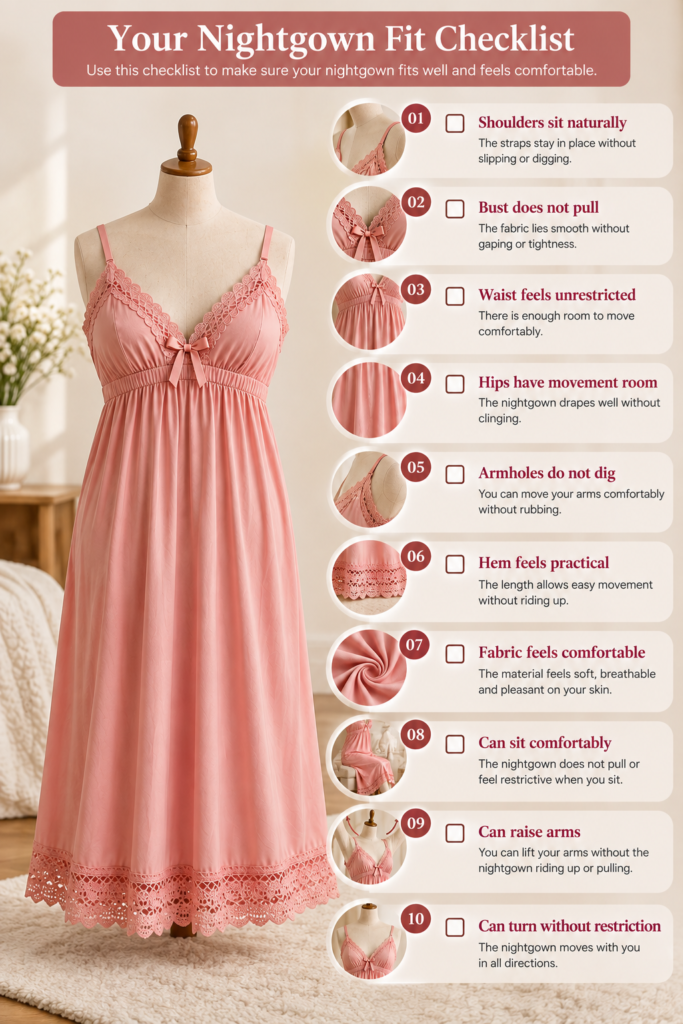
Before keeping a nightgown, ask yourself:
Shoulders
- Do the seams sit naturally?
- Can I raise my arms comfortably?
Bust
- Does the fabric lie smoothly?
- Does the neckline stay comfortable?
Waist
- Can I sit and bend without pressure?
- Does the gown let my stomach relax?
Hips
- Can I sit without pulling?
- Can I turn without the gown catching?
Length
- Does the hem provide the coverage I want?
- Can I walk without stepping on it?
Movement
- Can I reach?
- Sit?
- Bend?
- Walk?
- Turn?
Fabric
- Does it feel comfortable against my skin?
- Does it behave the way I want when I move?
If you can answer yes to most of these questions, you are probably much closer to the right fit than a size label alone can tell you.
So, How Should a Nightgown Fit?
The ideal nightgown should skim rather than squeeze, move rather than restrict, and provide enough room without drowning your body in fabric.
Start with your bust, waist, hip, shoulder, and length measurements. Then compare them with the specific garment’s size chart.
But do not stop there.
Think about how the nightgown behaves when you sit, bend, walk, stretch, and turn in bed. Consider the fabric. Consider your height and proportions. Consider whether you prefer a fitted, skimming, relaxed, or oversized silhouette.
And remember that the best fit is not necessarily the smallest size that technically fits your measurements.
It is the one you stop noticing once you put it on.
For more practical guidance across sleepwear and intimate garments, explore Nightie Wear, including our complete guide to sleepwear fabrics.
You can also learn more about What Is Nightie Wear? Who Are We? to understand the broader purpose behind the Nightie Wear learning platform.
Frequently Asked Questions
Should a nightgown be tight or loose?
A sleep-focused nightgown generally works best when it feels relaxed or lightly skimming rather than tight. It should provide enough room for movement without creating so much excess fabric that it bunches or twists.
Should I size up in a nightgown?
Not automatically. If the garment feels restrictive, sizing up can help, but the problem may also come from the cut. Compare your measurements with the garment’s size chart and consider which area feels tight.
How much room should a nightgown have?
There is no single amount that works for every nightgown. The required ease depends on the garment’s silhouette, fabric stretch, construction, and intended use.
How do I know if my nightgown is too small?
Look for pulling across the bust or hips, restrictive shoulders, tight armholes, neckline movement, or a hem that rides up significantly when you move.
How do I know if my nightgown is too big?
Excess fabric around the shoulders, deep armholes, a constantly shifting neckline, excessive bunching, and fabric twisting around your body can indicate that the gown is too large.
Should a nightgown fit differently from a dress?
Yes. A nightgown is designed for comfort and movement during rest, so it often uses more ease than a fitted everyday dress. The correct amount depends on the particular sleepwear design.
What measurements do I need for a nightgown?
The most useful measurements are usually bust, waist, hips, and total length. Depending on the design, shoulder, underbust, sleeve, and arm measurements may also matter.
Should a nightgown be loose around the hips?
It should have enough room for you to sit, walk, and turn comfortably. The exact amount depends on the silhouette. A straight or fitted gown needs more careful hip sizing than a naturally flared A-line style.
Is it better to size up for sleepwear?
Not necessarily. A slightly roomier fit can feel more comfortable, but sizing up can also create excessive shoulder, neckline, and fabric volume. Choose based on the garment’s measurements and intended fit.
Why does my nightgown ride up when I sleep?
Riding can happen when the garment lacks enough room through the hips, when the fabric creates friction against your body or bedding, or when the cut does not work well with your sleeping movements.
Can fabric change how a nightgown fits?
Absolutely. Stretch, drape, weight, surface texture, and fabric construction can all change how the same measurements feel on the body.
How should a nightgown fit if I am between sizes?
Look at the garment’s intended silhouette and your largest relevant measurement. If the gown is fitted, prioritize the area where you need the most room. If it is already relaxed or A-line, you may not need to size up simply because one measurement falls between two sizes.
Leave a Reply